What the Law Says
The Legal Framework Governing the Significant Uniform of the RCMP
The wearing of the RCMP's significant uniform — the scarlet tunic known as the Red Serge — is not a matter of custom or tradition alone. It is a matter of law. Several distinct bodies of law govern who may possess, wear, and display the Red Serge, and each of them bears directly on the practice of civilian volunteers wearing it in RCMP-affiliated Pipes and Drums bands.
What follows is a plain-language account of the legal framework as it currently stands. The provisions cited are not in dispute. What is in dispute is whether they have ever been properly applied to the civilian band uniform question — and the evidence suggests they have not.
The RCMP Regulations, 2014 define and protect the significant uniform of the Force. The scarlet tunic — the Red Serge — is the significant uniform. Its design is not at the discretion of the Commissioner alone. It requires Ministerial approval.
This is the highest level of authority that applies to any RCMP uniform. No other uniform requires Ministerial sign-off. The significant uniform does — because Parliament recognized that it occupies a unique symbolic and legal position.
The question that follows directly from this provision is straightforward: did the Minister of Public Safety and Emergency Preparedness, or any predecessor minister, ever approve the wearing of the significant uniform by civilian volunteers in RCMP-affiliated Pipes and Drums bands? No document released to date under the Access to Information Act contains any evidence that such approval was ever sought or granted. The Access to Information requests filed in February 2026 and published on this site are designed to answer that question conclusively.
The 1998 Senior Executive Committee decision that authorized the kilted orders of dress was an internal RCMP committee decision. It was not a Ministerial approval. Whether that internal decision was sufficient authority to modify who may wear the significant uniform — and whether the civilian band practice that followed had any lawful basis — has never been formally examined.
Section 130 of the Criminal Code of Canada makes it a criminal offence to impersonate a peace officer. The provision has two distinct branches, both of which are relevant to the civilian band uniform question.
(a) falsely represents himself to be a peace officer or a public officer; or
(b) not being a peace officer or public officer, uses a badge or article of uniform or equipment in a manner that is likely to cause persons to believe that he is a peace officer or a public officer, as the case may be."
The maximum penalty for an offence under section 130 is five years imprisonment.
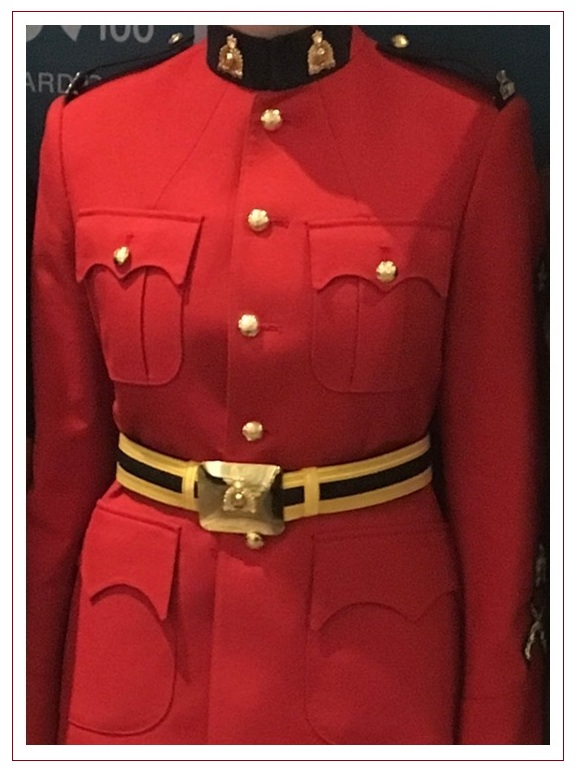
Branch (b) is particularly significant. It does not require intent to deceive. It requires only that the use of the badge or uniform is likely to cause a member of the public to believe the wearer is a police officer. The Red Serge is one of the most recognizable police uniforms in the world. Its scarlet colour, its cut, its brass buttons and collar dogs, and its association with the RCMP are known internationally. A civilian wearing it at an official RCMP event, in an RCMP-sanctioned band, performing alongside sworn officers, is by any ordinary reading doing precisely what section 130(b) describes.
This question was not examined at any point in the 1998 approval process. It was first raised in external correspondence in 2020, twenty-two years after the practice began. In 2025, the RCMP confirmed in correspondence with this author that the band uniforms had been formally assessed for compliance with section 130 — but that assessment was conducted only in response to external pressure, not as part of any original authorization process. The legal foundation for a twenty-seven-year practice was examined, formally, for the first time, after the question was publicly raised.
A change to RCMP internal Regulations cannot supersede the Criminal Code. Even if the RCMP Regulations were amended to permit civilians to wear the significant uniform, section 130 of the Criminal Code would still apply independently. The two bodies of law operate in parallel, and compliance with one does not guarantee compliance with the other.
The RCMP Act provides additional federal protection for RCMP uniforms and insignia. Sections 19 and 20 restrict the use of RCMP uniforms, badges, marks, and designations to authorized persons. The Commissioner may authorize specific uses, but that authorization must exist — it is not presumed.
The RCMP Act protection operates independently of the Criminal Code. A person who uses RCMP uniform items without the Commissioner's authorization may be in breach of the RCMP Act even if they have not technically impersonated a peace officer under section 130 of the Criminal Code.
Whether any instrument of authorization — a Commissioner's Standing Order, a policy directive, or a delegated authority document — was ever issued specifically permitting civilian volunteers to wear the significant uniform is one of the questions the ATIP requests filed in February 2026 are designed to answer. No such instrument has been identified in records released to date.
In the immediate aftermath of the April 2020 Nova Scotia mass casualty event — in which the perpetrator wore an RCMP uniform and drove a replica RCMP vehicle — Nova Scotia became the first province in Canada to pass legislation specifically restricting civilian possession of police uniform items. The Police Identity Management Act received Royal Assent in April 2021 and came into force on May 12, 2022.
The Act prohibits unauthorized persons from possessing, selling, reproducing or using police uniform items — including items that are currently in use by any police agency in Canada. The prohibition is not limited to RCMP items. It applies to all police uniforms currently in active use.
The Act defines a police uniform as distinctive clothing or equipment that is issued by a police agency to be worn by a police officer while on duty, or that has a colour scheme, pattern or style that makes the person wearing it readily identifiable as a police officer.
The Red Serge meets this definition on both counts. It is issued by a police agency to sworn officers for duty wear, and its colour scheme and style make the wearer immediately and universally identifiable as a member of the RCMP.
The authorized persons under the Act are limited to: active members of a police agency, police cadets acting in the course of their duties, and — critically — persons possessing police articles for a museum collection or exhibit or a dramatic work, but only for the duration of that collection, exhibition or work.
Civilian volunteers who are ongoing members of RCMP-affiliated Pipes and Drums bands — performing at regular public events, official RCMP ceremonies, and international tattoos — do not fall within any of these exemptions. They are not sworn officers. They are not cadets. Their possession and use of the uniform is not temporary, purpose-limited, or for a museum or dramatic work. Under the plain language of the Nova Scotia Police Identity Management Act, their possession of the significant uniform in its current form appears to be unauthorized.
Newfoundland and Labrador has since introduced equivalent legislation. Other provinces have not yet followed, but the direction of travel in Canadian law on this question is clear.
Nova Scotia is one of the provinces where RCMP-affiliated Pipes and Drums bands perform. The H Division band — whose debut in the new tartan and kilted uniform at the Nova Scotia International Tattoo in July 1998 was the event that made civilian inclusion a fait accompli — is based in Halifax. Whether that band's civilian members are in compliance with the Police Identity Management Act as it currently stands is a question that appears never to have been publicly examined.
The Mass Casualty Commission, convened following the April 2020 Nova Scotia tragedy, released its final report on March 30, 2023. Three recommendations bear directly on the civilian band uniform question.
Recommendation C.27 — calls for improved tracking of police impersonation cases, recognizing that the risk of impersonation is real, recurring, and inadequately monitored.
Recommendation C.28 — calls for improved management and disposal of police uniforms and associated kit. The Commission found that police uniform items — including Red Serge tunics — were circulating outside the Force without adequate controls. The recommendation calls for systematic tracking of who holds uniform items and how they are disposed of when no longer in authorized use.
Recommendation C.29 — calls for regulation of the personal possession of police paraphernalia. The Commission found that the ease with which RCMP uniform items could be obtained by civilians with no connection to the Force represented a public safety risk. The recommendation calls for federal legislative action to restrict civilian possession of police uniform items — equivalent to the provincial legislation Nova Scotia and Newfoundland and Labrador have already enacted.
As of the date of this page, no federal legislation equivalent to the Nova Scotia Police Identity Management Act has been enacted. The gap identified by the MCC at the federal level remains open. The RCMP's response, documented in correspondence with this author in 2025, confirmed that the band uniforms had been assessed for s.130 compliance and that shoulder flash panels bearing the word "POLICE" had been directed for removal from the grey shirt order of dress. These are administrative steps, not legislative ones. The underlying question — whether civilian band members are authorized under any instrument of law to possess and wear the significant uniform — remains unanswered in statute.
The MCC recommendations were directed at the problem of unauthorized civilians obtaining and wearing police uniforms. The RCMP's response has focused on disposal and tracking of surplus items. Neither the RCMP nor any federal department has publicly addressed the distinct question raised by this site: whether civilian volunteers who are ongoing authorized participants in RCMP-affiliated bands — wearing the significant uniform at official RCMP events with the knowledge and apparent blessing of the institution — are nonetheless in a legally uncertain position under the Criminal Code, the RCMP Act, the RCMP Regulations, and provincial police identity legislation.
Civilian Use of RCMP Uniforms in Pipes and Drums: Legal Analysis
Section 130 of the Criminal Code: Framework, Case Law, and Application
The case citations in Section II below are currently under independent verification through CanLII. Where a citation cannot be confirmed, it will be removed or corrected before final publication. All statutory provisions are quoted from publicly available official sources and are not in dispute.
I. Legal Framework
Under section 130 of the Criminal Code of Canada, a person commits the offence of personating a peace officer if they use a badge, article of uniform, or equipment in a manner likely to cause a reasonable person to believe they are a peace officer — regardless of intent or actual harm.
Canadian law emphasizes the objective likelihood of belief. It does not matter whether the person wearing the uniform intends to deceive, or whether anyone is actually misled. Courts have consistently affirmed that appearance alone can trigger liability, particularly when uniforms or other visual indicators suggest official authority. The question the court asks is not what the wearer intended — it is what a reasonable observer would have believed.
II. Leading Case Law
The following cases establish the principles courts have applied when assessing s. 130 liability. Note: these citations are pending independent verification through CanLII and will be confirmed or corrected before final publication.
Facts: The accused wore SWAT-style clothing, masks, and equipment while conducting what appeared to be an official police operation.
Issue: Whether visual presentation alone was sufficient to establish the offence under s. 130.
Holding: The court found that the victims' belief in the accused's authority was sufficient to satisfy the offence, even without verbal impersonation.
Wearing full RCMP dress and paraphernalia creates a similar objective impression of authority, even in a ceremonial context. The setting does not neutralize the appearance; it frames it.
Facts: The accused claimed to be an undercover police officer in order to intimidate a victim.
Holding: Conviction upheld despite brief doubt from the victim. Actual deception or harm was not required; the offence was complete upon the representation being made.
Civilian band members cannot rely on the argument "we mean no harm" to avoid liability. Benign intent is not a defence. The question is whether the representation — the wearing of the uniform — was objectively capable of inducing belief in authority.
The combination of uniform, badges, and RCMP-associated instruments — pipes, drums, and ceremonial paraphernalia — collectively signals authority to observers. The effect is cumulative. Each element that marks the wearer as RCMP reinforces the impression created by every other element.
Storrey is a well-established authority on the reasonable person standard in the context of belief and authority, though its core holding concerned arrest procedure. Its value here lies in the broader principle it affirms: courts do not ask what the individual victim believed — they ask what a reasonable person in that position would have believed. That standard is the operative test under s. 130(b). Whether Storrey is the best citation for this specific proposition in a s. 130 context is one of the questions the verification process will resolve.
Case Law at a Glance
| Case | Principle | Application to Civilian Pipe Bands |
|---|---|---|
| Vollrath (pending) | Visual presentation alone can create an impression of police authority | Full RCMP uniform and gear in a band context can satisfy the s. 130(b) threshold |
| Palinker (pending) | No intent to deceive or actual harm required | Ceremonial musical activity does not remove liability under s. 130(b) |
| Whitfield (pending) | Authority can be conveyed symbolically through visual cues | RCMP name, badges, buttons, belts, RCMP titled music instruments, marching in military formation collectively reinforce perceived police authority |
| Storrey (verify application) | Courts apply an objective reasonable person standard | Any reasonable observer could believe pipes and drums band civilians are serving RCMP members |
III. Objective Risk Factors in Civilian Pipes and Drums
When civilians wear RCMP-style uniforms, several converging factors increase the objective likelihood of mistaken belief under s. 130. These factors do not operate independently — they compound one another. Each one adds weight to the reasonable observer's impression; taken together, they present a case that is difficult to distinguish from the conduct the section was designed to prohibit.
Full Red Serge and police badges, gold belts, RCMP wedge caps, badges bearing the word "POLICE," RCMP/GRC shoulder flashes, ceremonial RCMP drums and RCMP maces. Each item is individually associated with RCMP authority. Worn together, they present a complete visual system that is internationally recognized as the dress uniform of the Royal Canadian Mounted Police.
Performing as "RCMP Pipes and Drums" — the name itself — signals official association to any ordinary observer. The RCMP has not distanced itself from this branding; in most cases it has actively promoted it. The institutional endorsement implicit in the name compounds the visual impression created by the uniform.
Civilian volunteers routinely perform alongside serving RCMP members, including at ceremonies attended by the Commissioner and other senior RCMP Officers. This proximity reinforces, rather than dilutes, the appearance of official RCMP status to civilians. To the observer, it confirms that the civilians are part of the same RCMP — because, visually, they are indistinguishable from it.
There is no practical way for a reasonable observer to distinguish a civilian musician from an actual RCMP member when uniforms, badges and equipment are nearly identical. No distinctive colour, no visible disclaimer, no marking of any kind separates them. The indistinguishability is not incidental — it is structural. It was built into the program and the uniform design from the outset beginning in 1998.
Civilian bands could wear distinctive ceremonial attire, altered colours, modified insignia, or visible disclaimers to reduce the risk of mistaken belief. The failure to adopt any such distinction — despite objections raised within the RCMP as early as January 1998 — is legally significant. It is not merely an administrative oversight; it is a choice that has been maintained for twenty-seven years, and it is a choice that has legal consequences under the objective test in s. 130(b).
For the entirety of the RCMP's history prior to July 1998, the scarlet tunic was worn exclusively by sworn members of the Force. No civilian had ever appeared in the Red Serge at an official RCMP event. The practice that began at the Nova Scotia International Tattoo in 1998 was without precedent — and it was introduced without public announcement. Spectators at those events had no reason to suspect that any performer in the scarlet tunic was not a serving RCMP officer. None would. The visual language of the Red Serge had carried a single, unambiguous meaning for over a century: the person wearing it was a police officer. That meaning did not change in 1998. Only the facts on the ground did — quietly, and without any public accounting.
The Access to Information records released in connection with this site span 59 documents — emails, meeting minutes, position papers, and formal policy submissions — covering the period from January 2 to April 16, 1998. On one question, the record is unambiguous: no public announcement was ever made that civilians would be wearing the Red Serge.
What the record shows instead is a deliberate pattern of internal confidentiality. The CEDC Folio — the formal document that first acknowledged civilians wearing the red serge as an emotionally charged and sensitive issue — was marked DO NOT DISTRIBUTE. The pre-SEC strategy memo circulated by one planner to Tartan Subcommittee members on April 9, 1998, six days before the SEC decision, explicitly asked recipients to refrain from forwarding it. The SEC Record of Decision itself — the instrument that formally approved the RCMP tartan — was an internal governance document. It was not published. It was not announced. It was not communicated to the public in any form that the released record discloses.
The Scottish Sunday Mail had published an article about the new RCMP tartan initiative as early as January 1998 — before formal approval had even been sought. That article said nothing about civilians. No subsequent press release, media communication, or public affairs strategy appears anywhere in the 59 documents addressing the question of who would be wearing the Red Serge at the Nova Scotia International Tattoo in July 1998.
One internal RCMP publication — the INFORMATION bulletin, March/April 1998, document reference A1168983 — came closer than any other document to addressing the civilian question in a form that could reach the broader membership. It is the only document in the released record that uses the words "The case for civilians wearing the RCMP uniform" in a heading. It merits close examination, because what it actually says is the opposite of a clear announcement.
The 'A' Division Bulletin frames the civilian/red serge question not as a settled matter but as an active negotiation. It states explicitly that talks are "now underway" between the Materiel Management Branch, the RCMP Tartan Committee, the CEDC, and the DSRRs "to come to an agreement on whether there should be a distinction between the civilian musicians uniform and that of the Regular Members." It adds that "a final decision is expected before June" — the month of the Princess Anne unveiling in New Brunswick and two months before the Nova Scotia International Tattoo. In other words, even in the one internal publication that addressed the question most directly, the civilian/red serge issue was presented to the membership as unresolved.
A second page of the same Bulletin states that RCMP pipers and drummers "and the civilians who make up these bands will be able to wear a tartan that specifically represents the RCMP." This is the closest the released record comes to stating that civilians would wear the new uniform. But it refers to the tartan — not to the Red Serge tunic. It does not say civilians would wear the scarlet tunic. It does not say civilians would be indistinguishable from sworn RCMP members. And it was published in an internal RCMP 'A' Division bulletin — not in any public-facing communication.
The INFORMATION bulletin of March/April 1998 is not a public announcement — it is an internal RCMP publication directed at members of the Force. No spectator of the public attending the Nova Scotia International Tattoo in July 1998 would have read it. No spectator at any subsequent RCMP Pipes and Drums performance would have had access to it. Even if they had, it would have told them only that the question of whether civilians would wear the red serge was, as of March/April 1998, still being negotiated. The Bulletin does not resolve the question it raises. It records a dispute in progress. By the time the first civilians appeared in Red Serge at the Nova Scotia International Tattoo in July 1998, that dispute had been resolved — by someone internally, without announcement, and without any communication to the public whose reasonable perception is the operative test under section 130(b) of the Criminal Code.
A reasonable observer at the Nova Scotia International Tattoo in July 1998 had access to no information that would have corrected the impression created by the uniform. The institution had that information. It chose not to share it. The public was left with what the uniform itself communicated: that every person wearing it was a member of the Royal Canadian Mounted Police. That impression has not been corrected in the twenty-seven years since. Under the objective test in section 130(b) of the Criminal Code, the absence of any public disclosure is not a mitigating factor — it is an aggravating one.
Taken together, these seven factors demonstrate that the objective appearance of authority created by civilian RCMP band uniforms is not incidental or marginal. It is complete, deliberate, and legally material — regardless of the ceremonial intent behind it. In short, a reasonable person cannot tell the difference between a civilian wearing the full RCMP uniform and a Regular Member (police officer) wearing the same uniform. RCMP Veterans as well cannot tell the difference between a civilian wearing the full RCMP uniform and a Regular Member (police officer) wearing the same uniform.
IV. Synthesis and Legal Implications
This is solely my view. The analysis in Sections I through III points toward a conclusion that is straightforward in its logic, if uncomfortable in its implications: the current civilian band uniform practice, as it has existed since July 1998, presents a credible and unresolved question of liability under section 130(b) of the Criminal Code of Canada.
That question has never been formally examined by the RCMP as part of any original authorization process. It was raised for the first time — from outside the institution — in 2020, twenty-two years after the practice began. The RCMP's 2025 assessment, while a meaningful step, was reactive rather than foundational. It addressed symptoms — most visibly, the direction to remove "POLICE" shoulder flash panels from the grey shirt order of dress — without resolving the underlying question: whether civilian possession and wear of the significant uniform was ever authorized under any instrument with legal force.
Section 130(b) operates independently of RCMP internal policy. An internal Regulation, a Commissioner's Standing Order, or a Senior Executive Committee (SEC) decision cannot override a provision of the Criminal Code. Even if the RCMP were to amend its own Regulations tomorrow to expressly authorize civilians to wear the significant uniform, that amendment would not, by itself, resolve the s. 130(b) question. The two bodies of law run in parallel. Compliance with one does not guarantee compliance with the other. As well, changes to the scarlet tunic would still need authority from the Minister.
The case law reviewed in Section II establishes that the test is objective: what would a reasonable person believe, looking at this uniform, in this context, at this event? The risk factors identified in Section III make the answer to that question difficult to dispute. A civilian in full Red Serge, performing under the RCMP name, alongside serving officers, at an official RCMP ceremony, wearing all the authentic buttons, badges and belts presents exactly the combination of visual cues that courts have found sufficient to establish the likelihood of belief required under s. 130(b).
The civilian band uniform practice is not a policy question dressed in legal clothes. It is, at its foundation, a legal question that has been treated as a policy question — and the difference matters. Policy questions can be resolved by internal committee decisions, administrative tolerance, and institutional momentum. Legal questions cannot. Section 130(b) of the Criminal Code does not yield to the passage of time, the good intentions of the participants, or the institutional prestige of the events at which the uniform is worn. It asks one question, and the evidence on this page suggests the answer has never been formally given.
Conclusion
Even in a ceremonial context, civilians in pipe bands wearing RCMP-style uniforms, using RCMP paraphernalia, and performing in the presence of serving RCMP members create a legally recognized perception of police authority. That perception meets the threshold for liability under s. 130(b) of the Criminal Code, independent of intent or harm. The ceremonial setting does not neutralize the legal exposure — it frames it. The question the section asks is not what the band intended. It is what a reasonable observer would have believed. On the evidence reviewed here, that question has a clear answer.
Citizen bands wishing to reduce their exposure under s. 130(b) should consider the following measures. Each addresses one or more of the objective risk factors identified in Section III, and each reduces the likelihood that a reasonable observer would mistake a civilian band member for a serving RCMP officer.
- Modify uniforms to be clearly civilian — a distinct colour, cut, or material that visually separates civilian musicians from sworn RCMP members.
- Use distinct badges or insignia — replacing or removing RCMP-specific insignia, including any badge or flash bearing the word "POLICE," with civilian-appropriate alternatives.
- Publicly clarify the ceremonial nature of the group — through programs, introductions, or visible signage at events, making clear to observers that the band includes civilian volunteers who are not sworn members of the Force.
These steps mitigate the objective likelihood of mistaken belief. They do not require the dissolution of civilian band participation — only that it be visually distinguished from sworn RCMP membership in a way the law can recognize.
Footnotes
- Criminal Code, RSC 1985, c. C-46, s. 130, Government of Canada, https://laws-lois.justice.gc.ca/eng/acts/C-46/section-130.html.
- R. v. Vollrath, 2016 ABPC 130 (Alberta Provincial Court), CanLII. — Pending verification.
- R. v. Palinker, 2008 ONSC 15776 (Ontario Superior Court of Justice), CanLII. — Pending verification.
- R. v. Whitfield, 1969 SCC 4, Supreme Court of Canada. — Pending verification.
- R. v. Storrey, [1990] 1 SCR 241, Supreme Court of Canada. — Verify application to s. 130(b) context.
Summary: The Legal Framework at a Glance
| Legal Instrument | Requirement | Applied to Civilian Bands? |
|---|---|---|
| RCMP Regulations 2014, s.27(1) | Ministerial approval required for the design of the significant uniform | No evidence of approval |
| Criminal Code, s.130(b) | Prohibition on using uniform in a manner likely to cause public to believe wearer is a peace officer | Assessed 2025 only — not in 1998 |
| RCMP Act, ss.19–20 | Commissioner's authorization required for use of RCMP uniforms and insignia | No instrument of authorization identified |
| NS Police Identity Management Act, 2022 | Possession of police uniforms restricted to sworn officers and specific limited exemptions | Civilian band members do not fall within any exemption |
| MCC Recommendations C.27–C.29, 2023 | Improved tracking, disposal, and regulation of police uniform possession | Partially addressed — no federal legislation enacted |
Each of the five legal instruments listed above points toward the same gap. The significant uniform of the RCMP is among the most legally protected items of clothing in Canada. Its design requires Ministerial approval. Its use is restricted by the Criminal Code, the RCMP Act, and — in Nova Scotia — by provincial statute. Yet no document released to date establishes that any of these legal requirements were ever formally applied to the question of civilian volunteers wearing the Red Serge in RCMP-affiliated Pipes and Drums bands.
This was not for want of warning. The internal RCMP record — spanning January to May 1998 and documented in detail through Access to Information releases — shows that the civilian uniform question was raised, objected to, and left unresolved no fewer than thirteen times across six distinct channels of authority over a period of five months. The objections came from every level of the RCMP.
Thirteen objections: A Regular Member raised it informally in January 1998, stating he had a major problem with civilians wearing any type of red serge uniform and that others in his division felt the same way. A Deputy Commissioner raised it formally in writing in February 1998, questioning the motivation and direction of the initiative. The Divisional Staff Relations Representatives (DSRRs) — the body representing the views of the entire RCMP membership — formally objected at the CEDC meeting in February 1998, stating that the membership would not support civilians wearing the Scarlet Tunic, and compared the prospect to the public outcry that had erupted when summer students were seen wearing the Red Serge on Parliament Hill. The DSRRs objected at the SEC meeting. The designated DSRR representative in Regina wrote directly to the initiative's co-chair in March 1998, stating in plain terms that the tartan initiative was a good one but that the only concern was the wearing of the red serge by civilians. The same objection was recorded in the formal submission to the Senior Executive Committee (SEC) in April 1998. And after the SEC decision, a Constable from within the initiative's own division — a published authority on RCMP uniforms — wrote directly to the CEDC Chair in May 1998 proposing a workable compromise and warning that the RCMP's regimental traditions were being disregarded. His letters were copied to the SEC and to the Corps Sergeant Major. There is no evidence in the documentary record that any of them received a reply. In addition, on April 16, 1998 — the day after the SEC meeting — the CEDC Chair wrote to the tartan planning committee confirming that the SEC decision was unequivocally for Regular Members only.
At no point in this process did anyone ask the question that the law required to be asked: had the Minister approved this? Had the Commissioner issued a formal instrument of authorization? Did the practice comply with section 130 of the Criminal Code? Those questions were not raised in 1998. They were not raised in the years that followed. They were raised for the first time — from outside the institution — in 2020, twenty-two years after the practice began.
The 1998 Senior Executive Committee (SEC) decision authorized the tartan and kilted orders of dress for Regular Members. It ignored the civilian question. That deferral was never resolved by any instrument with legal force. The civilian band practice that followed was built on momentum, internal policy documents, and administrative tolerance — not on a chain of legal authorization that could withstand scrutiny under the instruments described on this page. Thirteen objections were raised and set aside. Not one of them prompted a legal review. Not one of them produced a Ministerial approval, a Commissioner's Standing Order, or a formal legal opinion. The institution moved forward because the initiative had powerful internal advocates, immovable external commitments — a royal ceremony, a national tattoo — and nobody in authority who was prepared to stop it.
The Access to Information requests filed in February 2026 are designed to determine whether that chain of authorization exists anywhere in the documentary record. If no such authorization is found, the problem is not simply one of poor record-keeping or administrative oversight. It is a legal problem — one that has existed since the first civilian wore the Red Serge at the Nova Scotia International Tattoo in July 1998, and that has never been identified, examined, or resolved in the twenty-seven years since.
Nothing on this page constitutes legal advice. The author is not a lawyer. All statutory provisions are quoted from publicly available official sources. All interpretations and conclusions are the author's own.