An Essay:
No Authentic Roots:
Colonial Ceremony, Civilian Accountability,
and the Face of RCMP Pipes and Drums
Disclaimer: This essay is written in an exploratory, academic tone. It does not allege wrongdoing or assign blame to any individual, group, or organization. It seeks only to examine legal, symbolic, and institutional questions related to the RCMP scarlet tunic and the pipes and drums tradition. All historical interpretations and conclusions are the author's own.
There is something worth pausing on when you watch the RCMP's pipes and drums march through a ceremony. The sound is stirring. The precision is impressive. And yet the spectacle raises a question that the Force has never quite had to answer out loud: why does a civilian police service present itself in the ceremonial tradition of a Highland military regiment? It is a question that opens into a much larger one about what the RCMP considers its identity, and whether that identity is consistent with the law, the history, and the values the Force has publicly committed to uphold.
I. The Legal Reality
The RCMP is not a military organization. It is constituted under the Royal Canadian Mounted Police Act, not the National Defence Act. Its members are peace officers under the Criminal Code, not soldiers subject to military justice or the Code of Service Discipline. The RCMP answers to the Minister of Public Safety and to the Civilian Review and Complaints Commission. It operates under civil authority. By every legal and constitutional measure, the RCMP is a civilian body — not a garrison, not a regiment, not an arm of the military.
That legal reality has a direct bearing on the question of the pipes and drums. When Prime Minister John A. Macdonald established the North-West Mounted Police in 1873, he was explicit on one point: the Force was to be civil rather than military in character. He and his ministers resisted proposals for a military-style organization or garrison, insisting that the Mounted Police derive its authority from civil law and civil accountability, not from the chain of command of an armed force. That founding principle was not incidental — it was constitutional to the RCMP's identity and public mandate.
What is therefore striking is that when the RCMP did adopt pipes and drums — in 1998 — it reached not into its own history, but into the ceremonial culture of the very military tradition its political founder had deliberately rejected.14, 16
II. Where the Pipes and Drums Actually Come From
The pipes and drums are not a Canadian invention. They are a Scottish Highland military tradition carried forward by British imperial regiments. Crucially, they were never part of the early North-West Mounted Police, and they played no role in the RCMP's institutional culture for the first 125 years of the Force's existence. As established in the No History, No Mandate section of this website, the RCMP Quarterly — the Force's own institutional journal, published continuously from 1933 — contains no reference to bagpipes, pipe bands, or Highland music in any issue prior to 1998.
The original purpose of pipes and drums on the battlefield was unambiguous: they were instruments of war. Highland regiments used them to signal charges, rally troops under fire, and march men toward combat. That function has no place in the culture of a modern civilian police service whose mandate is the protection of individuals, the preservation of rights, and the maintenance of public order within a democratic society. When the RCMP adopts this tradition ceremonially, it borrows not just the aesthetic but the association — and that association is with warfare, not with policing.
Every element of the pipes and drums performance speaks the language of the battlefield: the regimental drums whose original function was to set the pace of an advancing army, the rigid military bearing, the precision marching inherited directly from infantry drill, and the uniform itself — adorned with the visual grammar of a fighting force, including rank insignia, baldrics, and regimental battle honours. The RCMP's own official website confirms that the regimental drums bear battle and campaign honours from South Africa, both World Wars, the Former Yugoslavia, and Afghanistan — and that the band's membership explicitly includes "serving members of the Force, employees and citizen volunteers." 15
The tension between those two facts — military honours on one hand, civilian volunteers on the other — is one this research examines directly. It is a tension that the RCMP's own official sources confirm, and that has never been formally resolved.
III. Civilian Volunteers in a Sworn Uniform
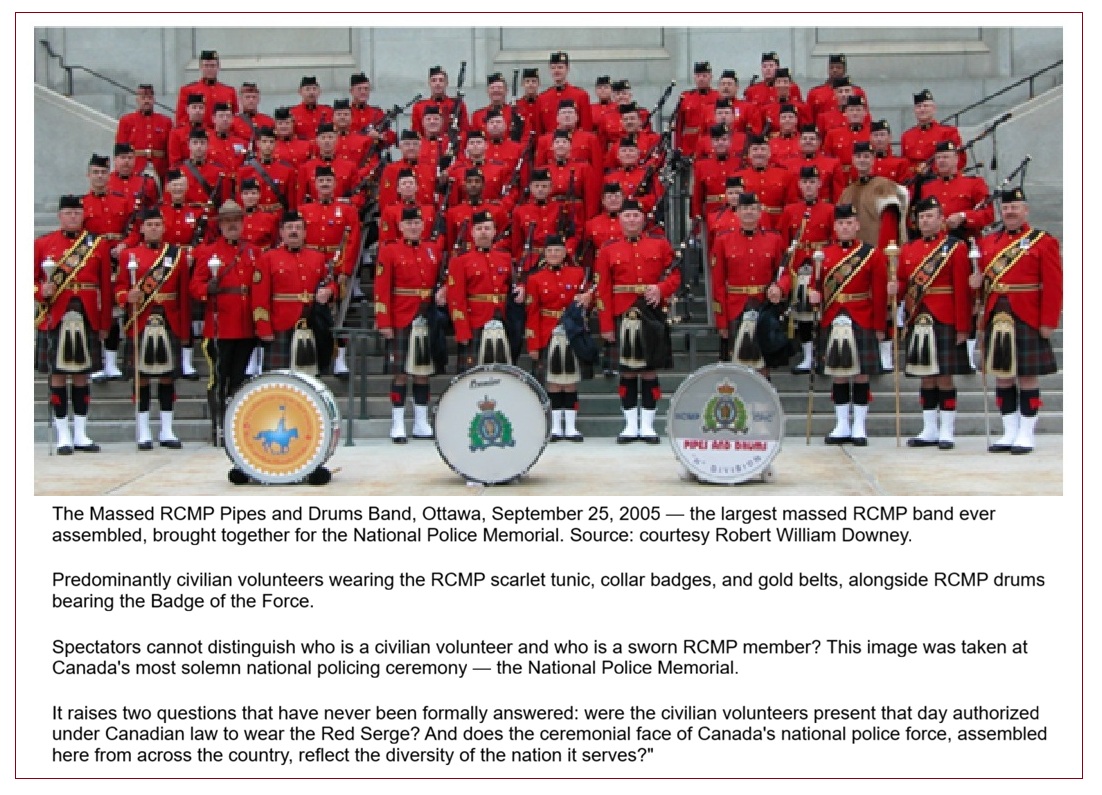
Most Canadians watching an RCMP pipes and drums ceremony have no idea that the vast majority of men and women wearing the RCMP's iconic scarlet tunic are not police officers. They are civilian volunteers — members of the public who have not taken an oath of service, have not completed training at 'Depot' Division, and hold no police authority whatsoever. The BC RCMP's own website classifies the Pipes and Drums Band explicitly as a volunteer community program, listed alongside Block Watch and Operation Red Nose, stating that volunteers "do not perform law enforcement or operational duties performed by Regular Members."17
This is not a criticism of those individuals. Many participate with genuine pride and a sincere desire to serve their community. The civilian volunteers who have worn the Red Serge in pipes and drums bands did so in good faith, on the basis of authority that was represented to them as sufficient. The question this research raises is not about their conduct — it is about the legal and institutional framework within which they were invited to participate, and whether that framework was ever properly established.
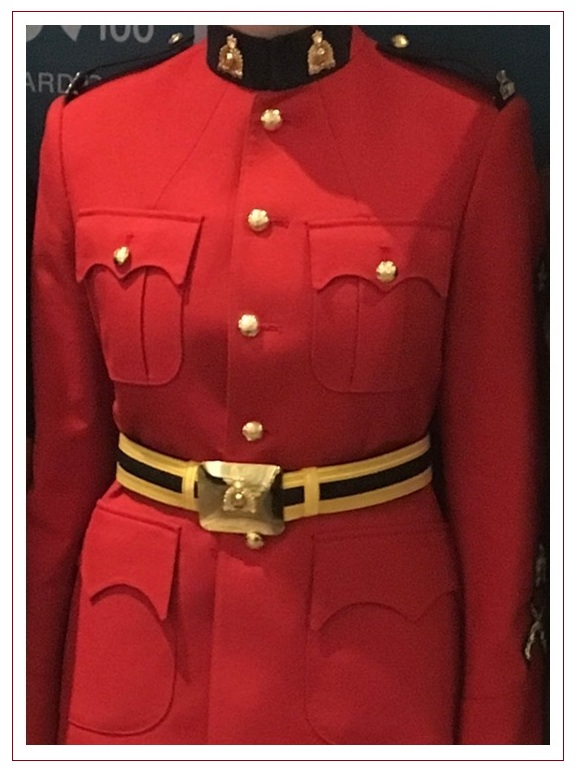
The Royal Canadian Mounted Police Regulations, 2014 restrict the significant uniform of the Force — including the scarlet tunic — to sworn RCMP members operating under Ministerial authority. That is not a technicality. It is a boundary that exists because the uniform carries legal meaning. When a sworn RCMP member appears in Red Serge, it communicates accountability, authority, and the full weight of civil law. When a civilian volunteer wears the same uniform in a public ceremony, that communication is made without the legal foundation the uniform is designed to represent — not through any intent to deceive, but through an institutional arrangement whose legal basis has not been publicly documented.
Beyond the legal question, the pipes and drums — with their martial bearing, their battlefield associations, and their regimental pageantry — communicate something that RCMP Basic Recruit Training is deliberately designed to move away from. Recruit training at 'Depot' Division is oriented toward peaceful resolution, de-escalation, community engagement, and the protection of individual rights. The civilian volunteers marching in pipes and drums formations have not received that training. They do not carry that institutional understanding. And yet they wear its most visible symbol before audiences of thousands, at home and abroad.
IV. A Question of Representation
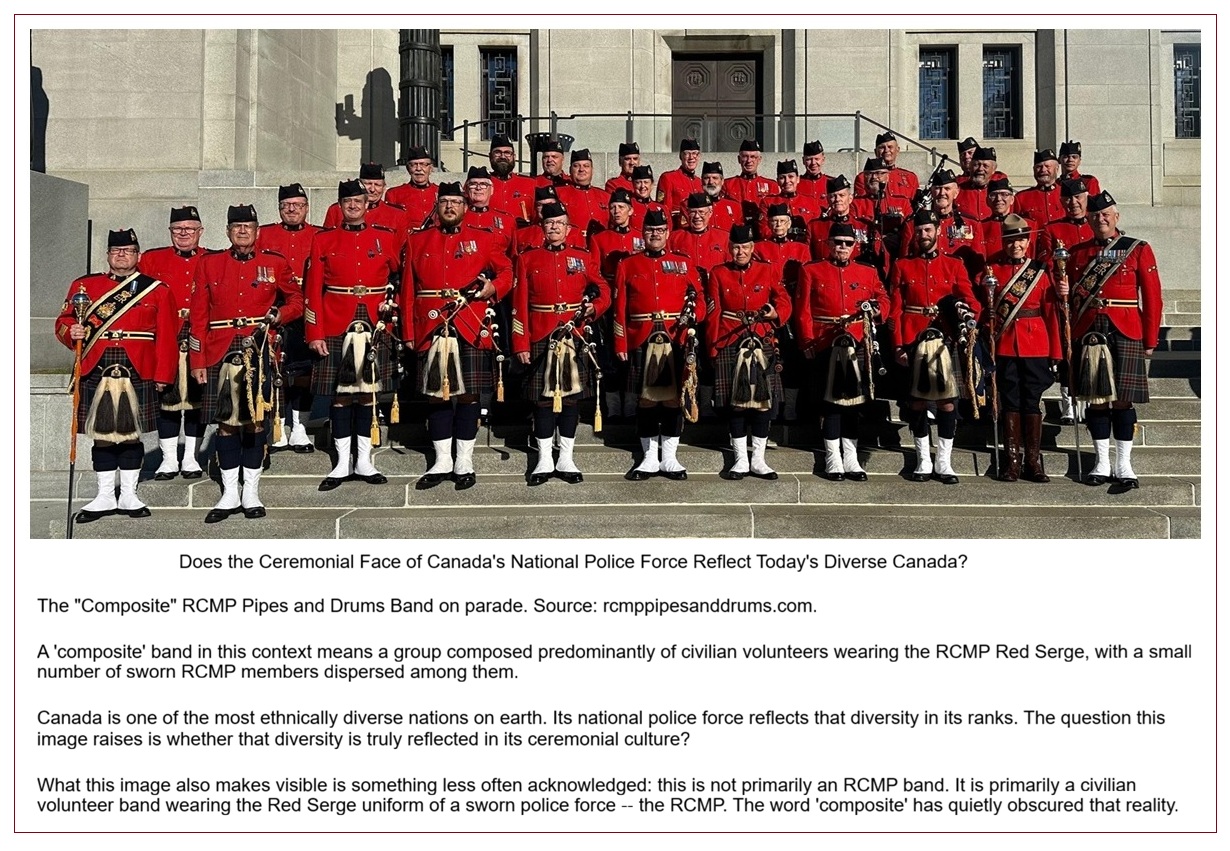
The RCMP of today is a genuinely multicultural organization, as reflected in its public diversity and inclusion reporting and in the composition of its membership across Canada. Its ranks reflect the full diversity of Canadian society — men and women of Indigenous, First Nations, Métis, and Inuit heritage, South Asian, East Asian, Southeast Asian, African, Caribbean, Latin American, Middle Eastern, francophone, and many other backgrounds serve in communities from coast to coast to coast. That diversity is the result of deliberate policy, decades of recruitment effort, and a sincere institutional commitment to reflect the Canada the RCMP serves.
That commitment is grounded in law. The Canadian Multiculturalism Act of 1988 declares that the federal government is committed to a Canada that recognizes and values the diversity of Canadians as a fundamental characteristic of Canadian society. Federal institutions are expected to reflect that diversity — not only in their hiring practices, but in their public face, their ceremonies, and the image they project to Canadians and to the world. The RCMP, as a federal institution, operates within that policy framework.
Against that standard, the pipes and drums present a question worth examining carefully and honestly. A ceremonial tradition drawn exclusively from one ethnic and cultural source — one with no documented roots in the NWMP's founding culture and no presence in the RCMP until 1998 — is worth examining in light of an institution's stated commitment to reflecting all Canadians equally.
Documents released under the Access to Information and Privacy Act confirm that in 1998, at the moment the pipes and drums program was being established, a serving RCMP officer raised the question of equitable cultural representation — asking why no other ethnic or cultural groups were being permitted to form their own musical groups within the Force. The record does not show that this question received a formal institutional response.
Ceremonial traditions carry meaning. They tell a story about who an institution is, what it values, and whose heritage it considers worthy of public expression. The RCMP proudly represents Indigenous officers, Sikh members authorized to wear the dastar on duty, officers of African, Caribbean, Asian, and francophone heritage — all serving with distinction, all carrying rich cultural and ceremonial traditions of their own. In that context, it is a fair and open question to ask why the ceremonial face of the institution is drawn exclusively from one cultural source that has no documented connection to the Force's founding history.
Canada is one of the most ethnically diverse nations on earth. The RCMP reflects that diversity in its ranks. Ukrainian-Canadians have served in the RCMP for generations — Ukraine being one of the largest ethnic communities in western Canada, the very region the NWMP was created to serve. Irish-Canadians have an equally long history of service in the Force. Indigenous, francophone, South Asian, and Caribbean-Canadian officers all serve with distinction and carry rich ceremonial traditions of their own. The question is not whether Scottish musical tradition has value. It does. The question is whether it alone should occupy the ceremonial space of a federal police force that serves — and is composed of — one of the most culturally diverse populations on earth.
The RCMP has taken meaningful steps toward reflecting its diversity in other contexts — the authorization of the dastar and the hijab for on-duty wear being among the most visible examples of the Force's willingness to adapt its ceremonial culture to reflect the diversity of its membership. The ceremonial role of the pipes and drums has not been subject to the same reflection. The RCMP's ceremonial culture could be genuinely and beautifully multicultural. Whether and how the Force chooses to consider that is ultimately a matter for its leadership. What this research suggests is that the question deserves to be asked — openly, honestly, and without prejudice to the many dedicated people, civilian volunteers and sworn members alike, who have contributed to the pipes and drums tradition in good faith.
V. Security, VIPs, and the Question of Vetting
The security question examined on the Governor General page of this website applies with equal force in this context. Pipes and drums bands affiliated with the RCMP perform regularly in close proximity to heads of state, senior government officials, members of the Royal Family, and other dignitaries. The band has performed at events attended by members of the Royal Family and has marched at the Royal Edinburgh Military Tattoo before international audiences. It has appeared at state funerals, official ceremonies, and high-security events across Canada and abroad. In each of those contexts, civilian volunteers in RCMP Red Serge — visually indistinguishable to any observer from sworn police officers — have moved freely in environments governed by the most stringent security protocols in the country.
The RCMP has indicated that civilian participants in the pipes and drums program are subject to security screening. A security check, even a thorough one, is not the same as the sustained institutional vetting that sworn members of the Force undergo throughout their careers — vetting that includes not only background checks but ongoing supervision, professional accountability, and the full disciplinary framework of the Royal Canadian Mounted Police Act. Civilian volunteers operate outside that framework entirely. They are not subject to the Code of Conduct. They cannot be disciplined as RCMP members.
The question of whether a background check conducted at the time of joining a volunteer pipe band constitutes adequate vetting for that level of proximity to protected persons is not one the RCMP appears to have answered publicly. It is a question that deserves a serious and transparent answer — not because there is any reason to doubt the integrity of individual band members, but because the institutional arrangement that places civilian volunteers in those environments has not been publicly examined in relation to that consequence and has not been formally justified on security grounds.3
VI. The Trust Question
Institutional legitimacy is built not just through outcomes but through the perceived consistency of an organization's values and symbols. When an institution's ceremonial culture sits in tension with its stated commitments, that tension is worth examining. An RCMP that has committed to being a modern, accountable, community-based civilian force — while continuing to present a ceremonial tradition rooted in 19th century Highland military culture, performed largely by civilian volunteers in the uniform of sworn members — is sending messages that deserve careful institutional attention.
At a moment when the RCMP has committed to rebuilding trust with Indigenous and racialized communities, to reflecting the full diversity of Canadian society, and to signalling through policy and practice that it belongs to all Canadians equally, the ceremonial messaging of the pipes and drums warrants honest examination. The question is a fair one — and it is one the Force has the capacity and the values to answer well.
VII. A Final Thought
None of this is an argument that the RCMP should have no traditions or no ceremony. Institutions need those things. The question is which traditions, and what they communicate. The North-West Mounted Police gained its historical distinction precisely through its attempts to establish order through presence and negotiation rather than through open warfare. That was a civilian approach — however imperfect, and however shaped by the colonial realities of its time — that defined the NWMP's founding identity. Pipes and drums belong to a different tradition — the military one that Macdonald deliberately rejected.
The more constructive question — and the more interesting one — is whether the Force might consider what ceremonies would more accurately reflect the values and diversity of the institution it has become. That is not a question this research can answer. It is a question for the RCMP's leadership, its Heritage Branch, and the Canadians the Force serves. What this research suggests is simply that the question has not yet been asked formally — and perhaps it should be.
Footnotes
3 Mass Casualty Commission, Turning the Tide Together: Final Report of the Mass Casualty Commission (Halifax and Ottawa, 2023). The Commission's findings regarding the perpetrator's use of an RCMP replica uniform are directly relevant to the question of institutional control over the significant uniform.
Additional sources supporting the analysis on this page are cited in full on the Sources & Authorities page of this website.
14 Royal Canadian Mounted Police, "They're the Reel Thing," RCMP News, November 5, 2021, available at rcmp-grc.gc.ca (accessed February 28, 2026). This article confirms that the National Division band was founded when the founding Drum Major asked the Pipe Major of the Ottawa Police Service whether there was room for another police pipe band in Ottawa, and that the program became official consistent with the documented 1998 founding of the RCMP pipe band program as an RCMP 125th Anniversary initiative, as confirmed by ATIP documents and the Commissioner's Record of Decision of April 15, 1998.
15 Royal Canadian Mounted Police, "RCMP Pipes and Drums Perform at the Royal Edinburgh Military Tattoo Aug. 7–29," available at rcmp-grc.gc.ca (accessed February 28, 2026). This official RCMP page confirms that the band "proudly wears the RCMP's iconic scarlet red tunic" and that its membership explicitly includes "serving members of the Force, employees and citizen volunteers." It further states that the baldric of the Drum Major and the regimental drums bear battle and campaign honours connecting the RCMP to service in South Africa, both World Wars, the Former Yugoslavia, and Afghanistan.
16 Royal Canadian Mounted Police, "Volunteering in the Blood," RCMP News, November 18, 2020, available at rcmp-grc.gc.ca (accessed February 28, 2026). The RCMP states that the pipes and drums program "started in 1998 as an RCMP 125th Anniversary initiative" and that participants are "predominantly citizen volunteers who provide their time and talent to represent the Force."
17 Royal Canadian Mounted Police, "BC RCMP — Career Opportunities: Volunteers," BC RCMP official website, available at bc-cb.rcmp-grc.gc.ca (accessed February 28, 2026). The BC RCMP's own website classifies the Pipes and Drums Band explicitly as a volunteer community program, listed alongside Block Watch, Operation Red Nose, Bike Rodeos, and Airport/Coastal Watches. The page states that volunteers "do not perform law enforcement or operational duties performed by Regular Members." This official classification confirms that pipe band participation is a civilian volunteer function, not a sworn police function — yet those volunteers wear the RCMP Red Serge. The tension between the two official RCMP positions is sourced entirely from the RCMP's own websites.
Canadian Multiculturalism Act, R.S.C. 1985, c. 24 (4th Supp.). The foundational federal statute establishing the Government of Canada's commitment to multiculturalism and the equitable participation of all cultural communities in Canadian public life.
Canadian Human Rights Act, R.S.C. 1985, c. H-6. The federal statute prohibiting discrimination in federal institutions on the basis of race, national or ethnic origin, and related grounds.
Documents released to the author under the Access to Information and Privacy Act, R.S.C. 1985, c. A-1, obtained from the Royal Canadian Mounted Police. Includes correspondence from a serving New Brunswick officer in 1998 raising the question of equitable cultural representation in the pipes and drums program.