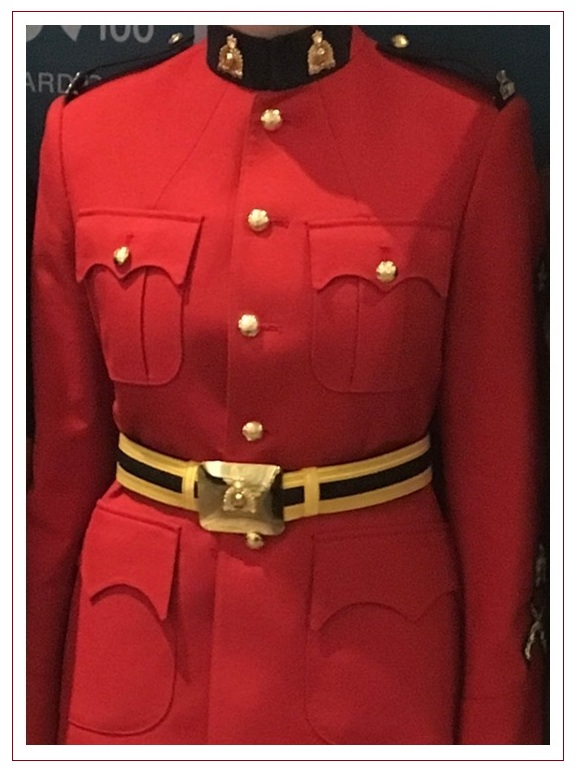
Disclaimer: This page is written in an exploratory, academic tone. It does not allege wrongdoing or assign blame to any individual, group, or organization. It seeks only to examine what the documentary record does — and does not — reveal about the 1998 Senior Executive Committee decision and its relationship to the civilian use of the RCMP uniform in pipes and drums bands. All claims are based on ATIP documents and sources cited herein. Nothing on this page is intended to impute wrongdoing to any individual.
The Statutory Requirement
"The significant uniform of the Force, the design of which is subject to approval by the Minister, consists of a felt hat, scarlet tunic, blue breeches with a yellow cavalry stripe on each side, brown Strathcona boots and jack spurs…"
Royal Canadian Mounted Police Regulations, 2014 (SOR/2014-281), s. 27(1)
The Ministerial approval requirement for the design of the significant uniform is established by Regulation. It applies to modifications of the uniform itself — independently of the question of who may wear it. The documentary record does not establish whether Ministerial approval for the 1998 modification was sought or obtained. That is a question the available documents do not answer.
Senior Executive Committee (SEC) Decision — April 15, 1998
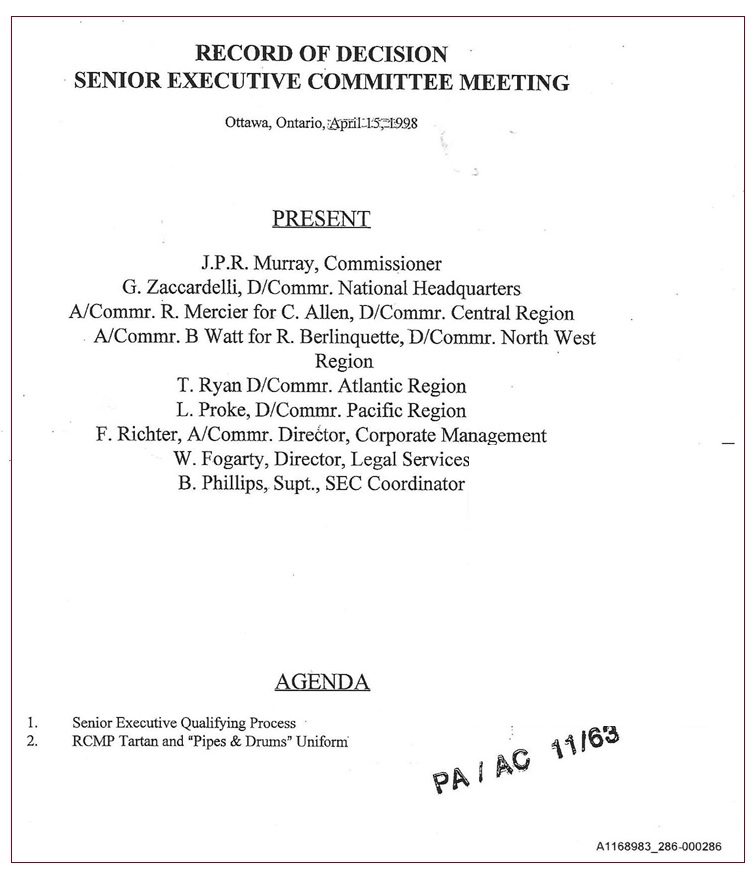
On April 15, 1998, the RCMP Senior Executive Committee (SEC) met to consider a proposal concerning a distinctive tartan and a kilted uniform for RCMP pipes and drums ensembles. The Commissioner's Record of Decision from that meeting is reproduced on this page as released by the RCMP under the Access to Information Act.
The purpose of presenting this Record of Decision is to provide transparency and allow the documentary evidence to be examined directly. The intent is not to criticize the RCMP or any individual involved in the decision-making process. By reviewing the Record of Decision, readers can assess what the SEC approved — and, equally importantly, what the Record of Decision does and does not address.
The Record of Decision
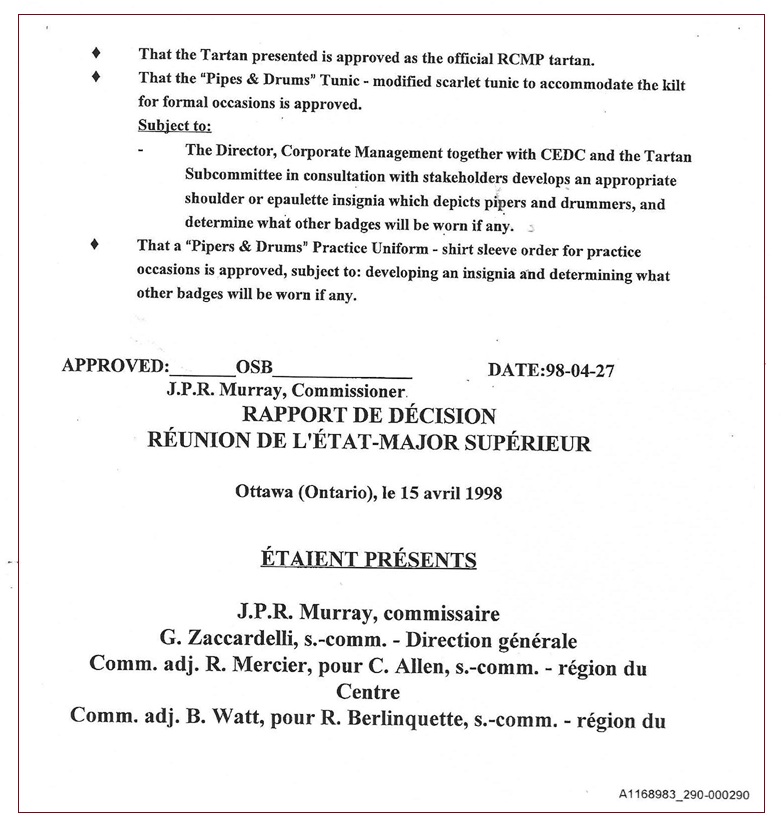
Decision:
♦ That the tartan presented is approved as the official RCMP tartan.
♦ That the "Pipes & Drums" tunic — a modified scarlet tunic to accommodate the kilt for formal occasions — is approved.
Subject to:
– The Director, Corporate Management, together with CEDC and the Tartan Subcommittee, in consultation with stakeholders, develops appropriate shoulder or epaulette insignia depicting pipers and drummers and determines what other badges will be worn, if any.
♦ That a "Pipers & Drums" practice uniform — shirt sleeve order for practice occasions — is approved.
What the Record Addresses
The Record of Decision is narrowly focused on three approvals: the official RCMP tartan, a modified kilted tunic for formal occasions, and a practice uniform for rehearsals. The insignia to be worn on the new tunic were left to be determined by a subcommittee in consultation with stakeholders — meaning the uniform's final design was not settled at the time of the decision itself.
The Record does not reference civilians, volunteers, or members of other police agencies. There is no guidance, directive, or policy framework within the document regarding whether non-sworn individuals might participate in RCMP pipes and drums ensembles, or under what circumstances they might wear aspects of the RCMP uniform. The documentary record released under the Access to Information Act does not identify a published policy that addresses these questions.
What the Record Does Not Address
Civilian and volunteer participation
The Record does not authorize civilian volunteers to wear the Red Serge uniform, nor does it establish a policy framework for their participation. No policy, directive, or regulation is cited within the document that would govern such use. The documentary record released under the Access to Information Act does not identify a document confirming such authorization.
The Role of the Department of Justice
Department of Justice (DOJ) legal services were present at the April 15, 1998 Senior Executive Committee meeting. The Record of Decision does not reflect any legal guidance or caution regarding the civilian participation question — specifically, whether the Commissioner had authority to extend the right to wear the RCMP uniform beyond sworn police officer members, and whether the modification to the Scarlet Tunic required Ministerial approval under the Royal Canadian Mounted Police Regulations. Those are precisely the questions one would expect legal counsel to address where a decision touches on regulated federal RCMP uniforms and the boundaries of executive authority. Had the SEC formally authorized civilians to wear the RCMP uniform, one would reasonably expect that decision to have attracted at least a word of caution or legal qualification from DOJ counsel — noting the Ministerial approval requirement, the limits of the Commissioner's authority, or the implications for Crown liability. The Record reflects none of that. The documentary record released under the Access to Information Act does not identify any document that fills that gap.
Observations on the Record
A careful review of the Commissioner's Record of Decision reveals that it does not cite any policy provision, regulation, or directive explicitly addressing civilian volunteers and the Red Serge tunic. The Record approves a tartan and a modified kilted uniform for the pipes and drums program. It does not address who, beyond sworn members, may wear that uniform.
In the author's professional experience, and as reflected in standard policing practice across Canadian jurisdictions, volunteers and auxiliary participants are typically provided with uniforms visually distinct from those worn by sworn officers. The Record does not indicate whether this consideration was examined in the context of the pipes and drums program.
Following the decision in April 1998, civilian volunteer musicians appeared in RCMP pipes and drums ensembles alongside serving or retired members in ceremonial settings. Early instances recorded in documents released under the Access to Information Act include the visit of Princess Anne in Fredericton in June 1998 and the International Tattoo in Halifax later that same month.
Further Documentary Evidence
One early description of the SEC decision appeared in the RCMP "A" Division newsletter Information (March/April 1998), which stated:
"This issue has always been contentious among members. The debate was rekindled when the Senior Executive Committee decided that members of the RCMP Pipes and Drums bands — that is, Force members and ordinary citizens — would be allowed to wear kilted versions of the uniform."
— RCMP "A" Division newsletter Information, March/April 1998
This newsletter predates the first documented civilian appearances in June 1998. It reflects how the decision was understood at the time within the organization — though the Record of Decision itself contains no explicit language confirming civilian authorization. This research does not suggest that this interpretation was made in bad faith; it reflects how the program developed in practice.
'H' Division, Nova Scotia
In addition to documented civilian appearances in June 1998, public accounts began to describe civilian participation in RCMP Pipes and Drums ensembles as formally authorized. The RCMP "H" Division Pipes, Drums and Highland Dancers website states:
"The band proudly wears the RCMP tartan kilt and world famous red serge tunic as its dress uniform. The tartan was designed in 1997 with colours derived from the RCMP uniform. The tartan was officially presented to the RCMP by HRH Princess Anne at a ceremony held in Fredericton, New Brunswick, in 1998, according to the band's public website. The civilian volunteers in the band are privileged and honoured to be permitted to wear the iconic red serge tunic of the RCMP."
— rcmppipeband.ca
While this account portrays civilian volunteers as formally permitted to wear the Red Serge, the Commissioner's Record of Decision of April 15, 1998 contains no explicit language authorizing civilians to wear the uniform. The public description reflects a secondary interpretation or customary practice that developed after the decision, rather than documented legal authority within the Record itself.
RCMP 'H' Division Handbook Statement
The RCMP 'H' Division Pipes and Drums of Nova Scotia Handbook makes the nature of this privilege explicit:
"We have been accorded a great honour and rare privilege in being allowed, as civilians, the right to wear the world famous red serge tunic and badges of the Force. Normally, this is a right granted only to those who have attended and graduated from the RCMP Training Depot in Regina and been sworn in as members of the Force. The importance of this cannot be understated [sic], particularly when you consider that Auxiliary Constables, who work side-by-side with Regular Members on a daily basis, are not accorded this privilege, so do not take it lightly."
— RCMP 'H' Division Pipes and Drums of Nova Scotia Handbook
A position with respect to the RCMP uniform that is without parallel in Canadian history
This Nova Scotia passage is significant for two reasons. First, the Handbook acknowledges, in its own words, that wearing the Red Serge is ordinarily reserved for sworn members who have completed training at 'Depot' Division. Second, it notes that Auxiliary Constables — who work operationally alongside Regular Members — are not accorded the same privilege. The Handbook therefore records, in the band's own language, that the civilian volunteers occupy a position with respect to the uniform that is without parallel even among those (Auxiliary Constables & Special Constables) who serve alongside sworn RCMP members on a daily basis.
Public accounts from other RCMP-affiliated community bands describe civilian volunteers wearing the Red Serge in similar terms. The RCMP Pipes, Drums and Dancers of the National Capital Region state that the band "wears the very distinctive RCMP tartan and the world-renowned red serge of the RCMP" and is "comprised primarily of citizen volunteers." (rcmppipesanddrums.ca, accessed 2026.) These public descriptions demonstrate how civilian participation and uniform use are portrayed in band materials — and how that portrayal sits alongside the absence of explicit authorization in the documentary record.
Institutional Context: Modification of the Red Serge
The Record of Decision refers to a modification of the scarlet tunic to accommodate the kilt and sporran. Because the Red Serge is both an operational uniform and a widely recognized national symbol, modifications to its design would ordinarily involve careful institutional review. The Record does not indicate whether consultations with other federal stakeholders were undertaken in connection with this modification. The documentary record does not identify any such consultation.
Historical Precedent: The 1974 Red Serge Modification
A significant modern modification to the Red Serge occurred in 1974 when women were admitted to the RCMP as regular members for the first time in the Force's history. Adjustments to the uniform were required so that the scarlet tunic could be worn by women while maintaining its recognizable appearance. At that time the RCMP operated under the authority of the Solicitor General of Canada. That modification was confirmed through a formal federal process: Order in Council P.C. 1975-354, dated February 25, 1975, approved by the Governor in Council.
This historical example illustrates that significant modifications to the Red Serge have previously occurred within a formal federal decision-making framework connected to major institutional developments within the RCMP. The documentary record does not establish that the same framework was engaged in connection with the 1998 Pipes and Drums tunic modification.
Federal Authorities Normally Involved in Uniform Changes
Because the RCMP is a federal institution, modifications to official uniforms such as the Red Serge would normally involve review within several areas of government administration. Key bodies involved include:
- Privy Council Office
- Prime Minister's Office (PMO)
- Public Safety Canada
- Canadian Heritage
- Indigenous Services Canada
- Crown-Indigenous Relations and Northern Affairs Canada
- Treasury Board of Canada Secretariat
- Department of Justice Canada
- Office of the Governor General
- Canadian Human Rights Commission
- RCMP External Review Committee
Each of these bodies plays a distinct role in the oversight or approval of changes to federal institutional symbols and dress, as detailed below.
Minister Responsible for the RCMP
Today the RCMP falls under the Minister of Public Safety through Public Safety Canada, pursuant to the Department of Public Safety and Emergency Preparedness Act, S.C. 2005, c. 10. Historically this responsibility rested with the Solicitor General of Canada.
Treasury Board Secretariat
The Treasury Board Secretariat oversees federal policies related to government property, procurement, and administrative standards under the Financial Administration Act, R.S.C. 1985, c. F-11. Uniforms are part of federal materiel management.
Governor in Council
Certain RCMP regulations are approved by the Governor in Council through Orders-in-Council, as confirmed by the 1975 precedent regarding the women's significant uniform.
Internal RCMP Authorities
Within the RCMP, uniform policy is administered through the Commissioner's office and internal programs responsible for dress and equipment, pursuant to the Royal Canadian Mounted Police Act, R.S.C. 1985, c. R-10.
Heritage and Symbol Authorities
Because the Red Serge is widely recognized as a national symbol, changes affecting insignia or symbolic elements may also involve heritage authorities such as the Canadian Heraldic Authority.
Key Observations
Three observations arise from reviewing the Record of Decision in its historical and administrative context:
- The Record does not identify an explicit policy authority addressing civilian volunteers and the Red Serge.
- The decision refers to a modification of the scarlet tunic for pipe band activities.
- The Record does not describe whether consultations occurred with federal authorities normally involved in changes to official RCMP uniforms.
The pipes and drums program was new to the Force, having been established around 1998. As a program without historical precedent within the RCMP, it lacked the institutional standing that would normally support approval of a modification to the Red Serge by the responsible federal departments. Furthermore, pipes and drums did not carry an operational affiliation with the core policing responsibilities of the Force, raising the question of whether such a program would have met the threshold required for an exception to official uniform policy. Any such modification, even if treated as an internal matter, would still have required Ministerial approval — meaning the decision could not properly be characterized as purely administrative in nature.
If documentation addressing these matters exists elsewhere within RCMP policy or government records, it has not been identified in the material available through the Access to Information Act requests documented on this website.
Purpose of This Research
The purpose of this research is to document the historical development of RCMP pipe bands and to examine the policies and administrative practices that shaped their operation. The intent is not to diminish the cultural significance of pipes and drums in Canada, but to clarify how these traditions were organized within the RCMP and how civilian participation intersected with the institutional and legal framework of the Force.
Finding: The 1998 Senior Executive Committee decision authorized a purpose-built Pipes and Drums tunic — a modified scarlet tunic distinct from the operational Red Serge worn by sworn members. Under the Royal Canadian Mounted Police Regulations, 2014 (SOR/2014-281), s. 27(1), the design of the significant uniform of the Force is subject to approval by the Minister. This requirement is established by Regulation.
The documentary record does not establish that Ministerial approval for this modification was sought or obtained, nor does it document Ministerial authority for civilian wearing of RCMP uniform items. The absence of that documentation in the available record does not constitute proof that no such approval exists — but it does mean the question has not been answered by the documents disclosed to date.
These questions are examined further in the ATIP Requests section of this website.