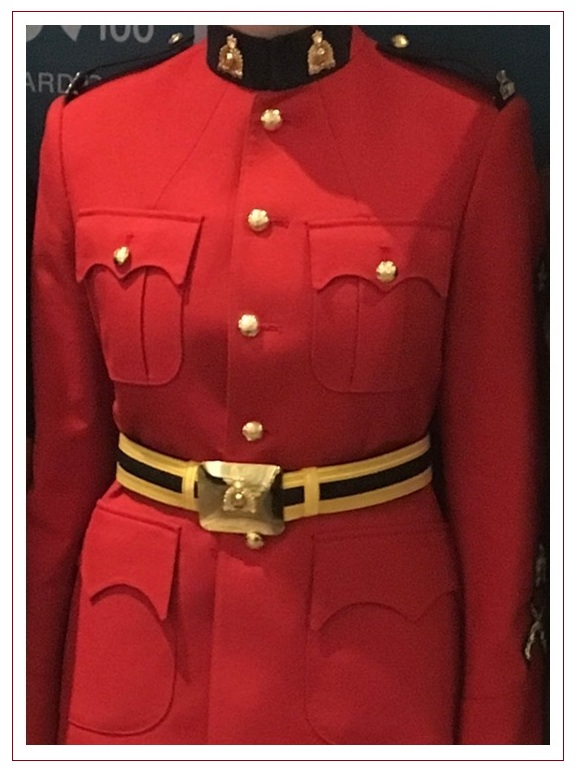
The Documentary Record:
Civilian Use of the RCMP Red Serge
Disclaimer: This page is written in an exploratory, academic tone. It does not allege wrongdoing or assign blame to any individual, group, or organization. It presents what the documentary record released under the Access to Information and Privacy Act does — and does not — show regarding the authorization of civilian use of the RCMP uniform. All claims are based on ATIP documents and sources cited herein. The absence of a document in the released record does not constitute proof that no such document exists. Nothing on this page is intended to impute wrongdoing to any individual. All historical interpretations and conclusions are the author's own.
Legal Notice Regarding Document Provenance: All documents reproduced or quoted on this page were obtained through formal requests made under the Access to Information Act, R.S.C. 1985, c. A-1. Their release was authorized by the RCMP Commissioner in his letter dated November 12, 2025, and by the Government of Canada through that process. Reproduction and analysis of documents obtained under the Access to Information Act for purposes of historical research, academic commentary, and public interest discussion is a recognized and lawful practice in Canada.
All personal names have been removed and replaced with descriptive identifiers out of respect for the privacy of individuals named in the original records. Nothing in the reproduction or analysis of these documents is intended to allege wrongdoing, impute misconduct, or assign personal blame to any individual. The observations and conclusions drawn from these documents are those of the author and represent an academic and historical interpretation of the institutional record.
This page does not constitute legal advice. The author is not a lawyer. Readers seeking legal guidance on any matter referenced herein should consult a qualified legal professional.
In historical and documentary research, the absence of a record can be as significant as its presence. When a comprehensive set of documents is assembled and examined, and a particular authorization or decision cannot be found within it, that absence is itself a finding — one that calls for a clear statement of what the record shows and what it does not show. This page presents that statement in relation to the central question of this research: what does the documentary record released under the Access to Information and Privacy Act show about the authorization of civilian use of the RCMP Red Serge?
The ATIP requests documented on this website sought records bearing on the authorization, legal basis, oversight, and institutional awareness of civilian volunteers wearing the RCMP Red Serge in pipes and drums bands. The documents released in response to those requests are the evidentiary foundation of this page. Where specific documents support specific claims, citation placeholders appear below — to be completed with ATIP request numbers, document titles, and dates as those references are finalized.
The documents released to date do not contain any authorization — at any time covered by the released record — for civilians to wear the Red Serge or any other component of the RCMP significant uniform. The documents that have been released instead reflect concern, expressed at multiple levels of the organization, that no such authority had been identified. That is a finding of this research. It is not proof that no authorization exists — it is a finding about what the released record shows.
What the Released Documents Show
The documents released under the Access to Information and Privacy Act show that when the question of civilian participation in RCMP pipes and drums bands was advanced within the organization, it encountered concern at multiple distinct levels. The nature of those concerns, as reflected in the released documents, is set out below. Each section identifies the level at which concern was expressed and the substance of that concern as it appears in the documentary record.
The records do not reflect a settled or uncontested decision. They reflect an institutional process in which significant concerns were raised — concerns about legal authority, symbolic meaning, institutional control, and the distinction between sworn and civilian status — without the documentary record establishing that those concerns were formally resolved.
Concerns Reflected in the Documentary Record
Divisional Staff Relations Representatives (DSRRs), presenting the views of RCMP members across the country, expressed concern that the Red Serge represented far more than ceremonial clothing. Within the Force, it has long been understood as a visible symbol of sworn authority, institutional identity, and public trust. The documents reflect membership-level concern that extending the Red Serge to civilian volunteers would undermine the historic relationship between the uniform and the status of a sworn peace officer.
The sensitivity of the membership response was acknowledged at the senior level — at least among those involved in the planning of the pipes and drums. Internal correspondence from February 1998 reveals that the DSRR caucus — the body representing the views of the entire RCMP membership — was considered a significant audience for any decision on civilian participation. One senior RCMP official wrote that he could "just imagine the response to a 'mountie band' with everything from banana pants to tartan sashes," adding that "we have one crack at doing this right." That language reflects an institutional awareness that the membership's reaction to civilian use of the Red Serge was a matter requiring careful handling — and that the stakes were understood to be reputational as well as institutional.
[CITATION: Insert ATIP request number, document title, and date of correspondence or minutes reflecting this concern]
RCMP members and Officers in operational settings raised practical concerns about public perception and legal authority. The Red Serge is widely recognized as a symbol of policing authority, and the documents reflect field-level concern that civilians wearing the uniform could create confusion about who possessed lawful authority — a concern with direct implications for public safety and institutional accountability.
[CITATION: Insert ATIP request number, document title, and date for field-level correspondence reflecting this concern]
Documentary Record: Internal RCMP Correspondence, January — February 1998
The following four documents were released under the Access to Information Act. All personal names have been replaced with descriptive identifiers in accordance with privacy considerations. Taken together, these documents establish that the question of civilians wearing the Red Serge uniform was actively debated internally within the RCMP in early 1998, that rank and file members had serious concerns about the practice, and that senior officials were simultaneously advancing plans for a new dress distinctive to pipers and drummers — without any reference to the statutory framework governing the significant uniform or to Ministerial authority. The following four documents illustrate these concerns as they were expressed in real time during January and February 1998. The documents are presented in chronological order.
Document 1: Internal RCMP Email, January 5, 1998
From: [RCMP Member]
To: [RCMP Member]
Subject: Tartan Registration - Title -Reply -Reply
"I'm not all involved in this Halifax Tattoo thing but I've heard we've been allotted 3 pipers' positions for this Division. I know of at least 7 interested members from "X" and if any civilians from "Y" go before regular members, I foresee a problem developing if this is the case. Lucky them to make those decisions. Are you going?"
An RCMP member from western Canada, writing to Ottawa on January 5, 1998, explicitly raises the concern that civilians from "Y" Division might take positions ahead of sworn RCMP members at the Halifax Tattoo. This directly corroborates the timeline of 1998 as the period when the question of civilian participation was actively being debated internally, and demonstrates that rank-and-file members had concerns about it at the time. It also shows that civilian participation was being considered long before the Clothing and Equipment Design Committee (CEDC) meeting, as well as the Senior Executive Committee (SEC) meeting on April 25, 1998.
Document 2: Internal RCMP Email, January 6, 1998
From: [RCMP "X" Division]
To: [RCMP Ottawa]
Subject: Halifax Tattoo -Reply
"Your points are well taken and let's not worry about it for now but if I, personally, was interested in going to Halifax (which I'm not) and being (modestly) a capable piper, and a regular member for 22 years, and involved with the tartan committee and with playing at hundreds of Force functions over the years and, am like many others who still have a major problem with civilians wearing any type of red serge uniform and was bumped due to a civilian being in the "K" Division band well............................I would not be a happy camper. I'm sure others in this Division would feel the same way. Let's wait and see!"
This email of January 6, 1998 is particularly significant. A senior RCMP member from western Canada with 22 years of service states plainly that he and many others had a major problem with civilians wearing any type of Red Serge uniform, and raises the specific concern of sworn members being bumped from positions in favour of civilians. Released under the Access to Information Act.
Document 3: Internal RCMP Email, February 9, 1998
From: [RCMP "HQ"]
To: [RCMP Eastern Canada]
Date: 2/9/98 7:34am
Subject: FOLIO — A TARTAN FOR THE RCMP AND ORDERS OF DRESS
DISTINCTIVE TO PIPERS AND DRUMMERS -R
"Approximately one year, during consultation process, I discussed
the potential of such attitude/comments with [OIC Diversity
Management Branch]. During my presentation of this new idea of
a Tartan for the RCMP to [OIC Diversity Management Branch], I
alluded to the unique side of a proposed multicolour tartan i.e.
7 colours being. Not only does it represent in part, our
Corporate colours, it also is representative of pluralism and a
multicultural society which we represent, work in partnership
with and indeed serve.
I know we will have an overwhelming support because the majority
of our membership is a ....forward and positive thinking
membership."
The quoted passage from [RCMP Eastern Canada], dated February 7, 1998, to which the above is a reply, is also notable:
"Just for your info - to date I have only had one dissenting view - that being a Director who questioned why we would support a Scottish kilt since it would open the door to every other nationality that came forward with a dress proposal. On the whole, I think there will be overwhelming support."
This document is significant in that it shows senior RCMP officials actively discussing and anticipating support for a new dress distinctive to pipers and drummers in February 1998, while also acknowledging at least one internal dissenting voice raising the broader implications of the proposal. Read alongside the two January emails above, it illustrates that within a single six-week period in early 1998, the RCMP in Ottawa was simultaneously fielding internal objections to civilians wearing the Red Serge and advancing plans for a new ceremonial dress — without any publicly documented resolution of the tension between those two positions.
Document 4: Internal RCMP Email, February 12, 1998 — [RCMP, HQ] to ["Y" Division Representative] (Page 2)
"I'm going to go out on a limb here and suggest/propose that I
draft a one or two page 'position paper' - complete with
recommendations - for 'RCMP Community-based Bands'. Among other
things it would make very clear that:
- there's a clear precedent, ie military and other police bands
post-war
- everyone wears the same uniform (other ranks, officers)
- no one wears rank/service badges, other than designated
positions
- designated positions include pipe major, pipe sergeant, drum
sgt/major
- pipers/drummers wear a 'musician badge' which identifies
them
In the event that we get a positive decision on our two main
issues, ie tartan and 3 orders of dress, then we can serve
notice that we propose to 'consult' with the subcommittee
(which includes ["Y" Division Representative] and by extension
the "Y" Div band). We can circulate the 'position paper' with
recommendations and get closure on this.
[RCMP Official, HQ], I don't see as we have much of a choice
here - the horse is out of the barn and we may as well address
it. My preliminary discussion with [RCMP Director] suggests
that he's on the same wave length (the only reason that they'd
go with drummers in banana pants is that they don't have enough
kilts!!! And he's proposing they wear 'glengarrys' with that!)
I simply think we need to take it in hand (like everything else)
and get it done right.
The timing is of consequence, ie first things first.
1. get the CEDC decision
2. serve notice that we propose to proactively address the
civilian issue
3. present the position paper with recommendations to CEDC and
advise that we intend to consult with the subcommittee to get
closure.
The CEDC will already be prepared to 'approve in principle'
knowing that [Senior RCMP Official]'s sign-off re the tartan
is pending. This will be seen as one more qualifier. And we
will be seen to have appropriately anticipated the
obvious.
I think, too, that if we make recommendations that a 'citizen
band' uniform be stripped of service/rank designation, it'll
be a MUCH easier sell to one and all. (ribbons and medals may
be worn, as per military and other police bands).
That same position paper and other briefing materials can be
sent to the DSRR caucus - they're going to know this is
happening one way or the other. I can just imagine the response
to a 'mountie band' with everything from banana pants to tartan
sashes ... We have one crack at doing this right. It appears
that its going to get done one way or the other.
I'll head home this evening [personal detail redacted] and see
what I can bang out."
Regards, [Senior RCMP Official, HQ]
Observations and Significance
This document, dated February 12, 1998, is one of the most substantive in the publicly released record. Three points warrant particular attention.
First, the author explicitly acknowledges that the civilian participation question is already beyond containment — the phrase "the horse is out of the barn" confirms that civilians were already participating in RCMP pipe and drum bands before any formal policy decision had been made. This is a direct admission that the practice preceded, rather than followed, any institutional authorization.
Second, the author proposes a three-step process for addressing the civilian issue — but notably, that process runs through the CEDC (Clothing and Equipment Development Committee) and an internal subcommittee, with no reference to Ministerial notification or approval. The legal framework governing the significant uniform — which vests authority in the Minister — does not appear to have been considered at this stage.
Third, the proposal that a citizen band uniform be "stripped of service/rank designation" is significant. It acknowledges that a distinct civilian uniform was both desirable and achievable. The removal of rank and service badges was in fact implemented in practice — at performances in Fredericton and Halifax in June 1998. However, the outcome was not a resolution of the indistinguishability problem but a confirmation of it: civilians and sworn RCMP members appeared identical in the same Red Serge uniform to the public, and no one noticed the difference. That inability to distinguish a civilian from a sworn RCMP member in uniform is precisely the concern this research identifies — and it remains unresolved in the documentary record. This concern — that the public cannot distinguish a civilian musician from a sworn RCMP member in an identical uniform — has since been validated at the highest levels of public inquiry in Canada, including by the Nova Scotia Mass Casualty Commission, which examined in detail the consequences of an unidentified individual wearing a uniform indistinguishable from that of a sworn police officer. The observations at Halifax in June 1998 are those of the author, who examined photographs of the Halifax performance, and who witnessed that no distinction between sworn RCMP members and civilian musicians was apparent to those in attendance.
Taken together, these four documents establish that by February 12, 1998 — more than two months before the Senior Executive Committee (SEC) meeting — some senior RCMP officials were aware of the civilian participation issue, were developing internal policy proposals to address it, and were doing so without reference to the statutory framework governing the "significant uniform" or to Ministerial authority. The record raises the question of what happened between these internal deliberations and the eventual SEC decision — and why the proposed civilian uniform was never fully implemented as a solution to the indistinguishability problem.
Senior Officers expressed concern over precedent, institutional discipline, and the integrity of the uniform. The documents at this level reflect apprehension that permitting civilians to wear the Red Serge would make it increasingly difficult to maintain clear boundaries on the use of RCMP uniform items and could erode longstanding institutional traditions regarding the relationship between the uniform and sworn service.
[CITATION: Insert ATIP request number, document title, and date for senior officer correspondence or memoranda reflecting this concern]
When consulted, staff of the Clothing and Equipment Design Committee — the body responsible for uniform standards and policy — raised concerns in the documentary record. They emphasized that the Red Serge was a regulated uniform item reserved for members of the Force, and the documents reflect concern that extending it to civilians would blur the distinction between official uniform dress and ceremonial costume, undermining the RCMP's established system of uniform control.
[CITATION: Insert ATIP request number, document title, and date for CEDC minutes or correspondence reflecting this concern — including the February 25, 1998 CEDC minutes if applicable]
The question was also considered within the Senior Executive Committee, the RCMP's senior leadership forum. At this level, the documents reflect concern about both the symbolic significance of the Red Serge and the authority required to regulate its use. The matter was treated as a question of institutional identity. The documents released to date do not reflect any discussion within the SEC of extending this practice to civilians, volunteers, or police officers from outside the RCMP — a finding that is examined in full on the SEC Decision page of this website.
[CITATION: Insert ATIP request number and date for the April 15, 1998 Commissioner's Record of Decision and any associated SEC correspondence]
The Central Issue: Authority
Across all levels reflected in the documentary record, the concern that recurs most consistently is the question of authority. The documents released to date do not identify a legal instrument — a Ministerial approval, an Order in Council, a Commissioner's Standing Order, or a formally documented policy directive — that authorizes civilian volunteers to wear the Red Serge. The documents instead reflect concern, expressed from the membership level through to senior leadership, that no such authority had been identified.
That finding does not establish that no authorization exists. It establishes that no authorization has been identified in the documentary record released to date — and that at the time the practice was being established, concern about the absence of such authority was expressed within the organization itself.
The ATIP documents released to date contain no reference to Ministerial approval having been sought or granted for the wearing of the Red Serge by civilian members of RCMP-affiliated pipes and drums bands. This finding is consistent across all ATIP requests documented on this website. A 'no records exist' response to the Ministerial approval requests filed pursuant to the Access to Information Act would itself be a significant finding — and would be published at redserge.ca as received.
What the Absence of a Record Means
In documentary and historical research, the absence of a record in a comprehensive search is itself a finding — one that must be stated precisely and qualified carefully. The following statement reflects the finding of this research as accurately as the available record permits:
Finding: A review of all documents released to date under the Access to Information and Privacy Act has not identified any authorization for civilian volunteers to wear the Red Serge or any other component of the RCMP significant uniform in pipes and drums bands affiliated with the Force.
The documents released instead reflect concern, expressed at multiple levels of the organization — from the general membership through to the Senior Executive Committee — that no such authority had been identified, and that the symbolic meaning and institutional control of the Red Serge required careful preservation.
The absence of an authorization document in the released record does not constitute proof that no such document exists. It does establish that the question has not been answered by the documents disclosed to date — and that it remains open. Responses to the ATIP requests filed pursuant to the requests documented on this website will be published at redserge.ca as they are received, and will be assessed in light of this finding.
A 'no records exist' response to the Ministerial authorization requests would be treated as confirmation that no lawful basis for the practice has been established in the documentary record — and will be reported accordingly.
Sources
1 Documents released to the author under the Access to Information and Privacy Act, R.S.C. 1985, c. A-1, obtained from the Royal Canadian Mounted Police. [INSERT: ATIP request numbers and response dates for all documents cited on this page]
2 Commissioner's Record of Decision, Senior Executive Committee meeting, April 15, 1998. Released under the Access to Information and Privacy Act. Examined in full on the SEC Decision page of this website.
3 Royal Canadian Mounted Police Regulations, 2014, SOR/2014-281, s. 27(1). Available at laws-lois.justice.gc.ca
4 Access to Information and Privacy Act, R.S.C. 1985, c. A-1. The legislative basis for all ATIP requests documented on this website. Available at laws-lois.justice.gc.ca