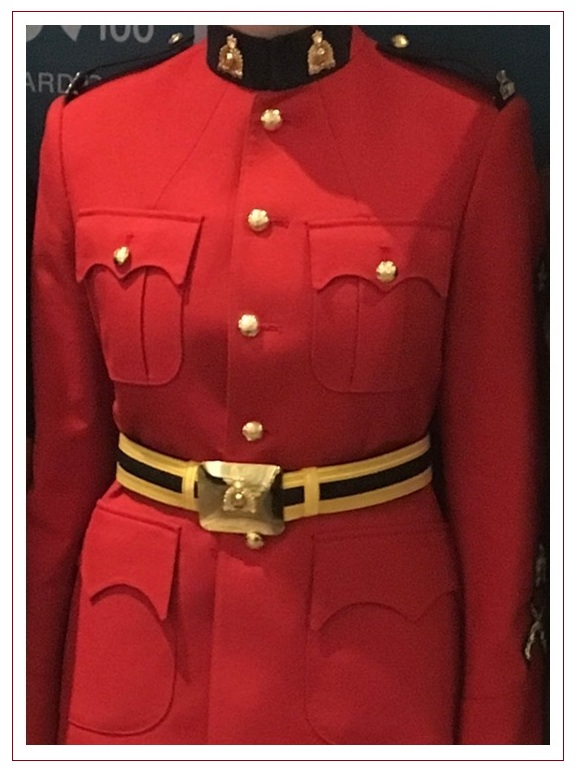
Civilian Use of the RCMP Scarlet Tunic
Statutory Foundations, Symbolism, and Public Perception
Disclaimer: This essay is written in an exploratory, academic tone. It does not allege wrongdoing or assign blame to any individual, group, or organization. It seeks only to examine legal, symbolic, and institutional questions related to the RCMP scarlet tunic. All claims are based on ATIP documents and sources cited herein. Nothing in this essay is intended to impute wrongdoing to any individual.
From the moment I first put on the Red Serge more than sixty years ago, I felt something stir that went far beyond pride or ceremony. It wasn't merely a uniform — it was a symbol of trust, honour, and service. The weight of the tunic rested not only on my shoulders but on generations of men who had worn it before me, each upholding the same ideals of integrity and duty.
The deep scarlet fabric carried a sense of belonging that no words could fully capture — belonging to a tradition that represented Canada at its best: disciplined, fair, and devoted to the protection of others. Each button, each crease, carried stories of sacrifice and quiet courage. To wear the Red Serge was to be part of something larger than oneself, to become a living thread in the fabric of national history.
Even now, decades later, that feeling has never faded. The sight of the tunic still evokes a swell of emotion — a mixture of reverence, gratitude, and quiet pride. It reminds me of the friendships forged, the challenges faced, and the unwavering sense of purpose that defined my years of service. The Red Serge is more than cloth; it is a living symbol of identity, duty, and devotion — and it remains deeply intertwined with who I am.
It is precisely because the Red Serge carries that weight — legal, symbolic, and deeply personal — that the question of who may wear it deserves a careful and honest examination.
I. The Uniform as Legal Instrument
The authority of the Royal Canadian Mounted Police is established under the Royal Canadian Mounted Police Act, R.S.C. 1985, c. R-10, which governs the organization, administration, and discipline of Canada's federal police service. Uniforms issued under that framework — including the scarlet tunic — function as both administrative identifiers and symbolic markers of lawful authority. They communicate to the public that the wearer is a sworn peace officer, accountable under statute, subject to the Code of Conduct, and operating within an established chain of command.
The specific authority governing who may wear the RCMP uniform is found in the Royal Canadian Mounted Police Regulations, 2014, SOR/2014-281. Section 27(1) provides that a member must wear the uniform issued to them, and that the Commissioner may make directions respecting the wearing of uniforms. The Regulations define "member" as a person appointed under the RCMP Act — that is, a sworn officer of the Force who has taken an oath of service, completed training at 'Depot' Division, and assumed the full legal obligations of a peace officer.
Royal Canadian Mounted Police Regulations, 2014, SOR/2014-281, s. 27(1): "A member must wear the uniform issued to the member in accordance with the directions of the Commissioner."
Understanding this legal foundation is important context for examining how the uniform is used in ceremonial settings — including settings that involve civilian volunteers. The documentary record this research has assembled raises questions about whether, and in what form, a policy framework governing such use has been publicly documented.
II. What the Uniform Communicates
The symbolic authority of the Red Serge is inseparable from its legal significance. When a sworn RCMP member appears in the scarlet tunic at a public ceremony, the uniform communicates a specific and legally grounded assurance: that the wearer is accountable under the RCMP Act, subject to the Code of Conduct, subject to the Civilian Review and Complaints Commission, and answerable for their conduct in law. That assurance is what gives the uniform its authority in the public imagination.
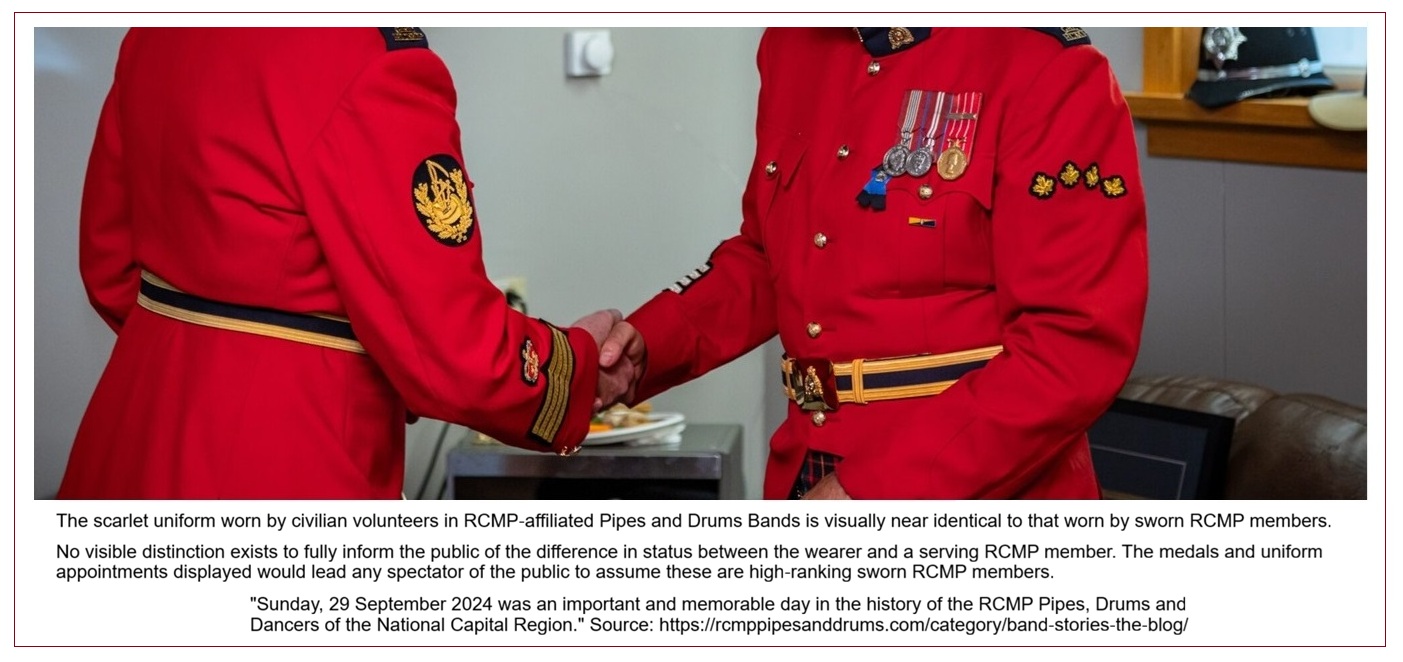
When a civilian volunteer wears the same uniform at a public ceremony, the visual signal to observers is identical. The public has no way of distinguishing, by sight, between a sworn member of the RCMP and a civilian volunteer in the same Red Serge. This is not a criticism of volunteers, who participate in good faith and with genuine dedication to the program. It is an observation about how uniforms function as public symbols — and why the policy framework governing their use in ceremonial contexts is a matter worth examining.
Section 130 of the Criminal Code of Canada, R.S.C. 1985, c. C-46, addresses the impersonation of a peace officer. This provision is noted here not to suggest that any individual has contravened it — the civilian volunteers who participated in RCMP-affiliated pipes and drums bands did so in good faith, on the basis of authority represented to them as sufficient, and no finding of criminal conduct is alleged or implied against any person. Rather, s.130 is relevant as a matter of public policy: it reflects Parliament's recognition that clear identification of those exercising police authority is important to the public interest. That policy principle raises a question worth examining — whether the institutional arrangements governing the ceremonial use of the RCMP uniform by civilian volunteers have been formally documented in a way that is consistent with that principle.1
As established on the Governor General page of this website, documents released under the Access to Information and Privacy Act confirm that the 1998 Senior Executive Committee decision that authorized the pipes and drums program does not document whether Ministerial authority for modifications to the Red Serge or civilian wearing of the Red Serge was sought or obtained. The documentary record does not answer that question — and this research identifies it as one that may benefit from further transparency. [See ATIP Requests]
III. Public Safety and the Integrity of the Uniform
One of the most significant public examinations of the importance of uniform integrity in Canadian policing is found in the findings of the Mass Casualty Commission, which investigated the mass shooting in Nova Scotia on April 18 and 19, 2020. The perpetrator wore a replica RCMP uniform and drove a replica RCMP vehicle. The Commission's final report, Turning the Tide Together, documented how the visual authority of the RCMP uniform — the public's instinctive trust in those who wear it — was central to the circumstances of that tragedy.
The Commission's findings establish a principle with broad relevance: that the integrity of the RCMP uniform is a matter of genuine public importance. Canadians extend a significant degree of trust to those who wear it, and that trust rests on the assumption that the uniform is worn by those who hold lawful authority. The Commission did not examine the pipes and drums program — its mandate did not extend to that question — and nothing in this research draws any equivalence between that program and the circumstances the Commission investigated. The relevant principle is simply this: the question of who may wear the RCMP uniform, and under what documented authority, is a matter of public policy that deserves a clear and transparent answer.2
The integrity of the RCMP uniform rests on the public's reasonable expectation that it is worn only by those who hold the authority it represents. Ensuring that expectation is supported by a clear, documented, and publicly available policy framework is a matter of institutional transparency — and one this research identifies as worthy of attention.
IV. Civilian Participation and the Question of Policy Documentation
The civilian volunteers who have participated in RCMP-affiliated pipes and drums bands deserve to be treated with respect in this analysis. Many have given years of their time and considerable personal commitment to a program they believed in. The question this research raises is not about their character or their dedication. It is about whether the policy and institutional framework within which they were invited to participate has been formally documented in a publicly accessible way.
As documented on the Sources page of this website, the RCMP's own official publications confirm that the pipes and drums program began in 1998 as an RCMP 125th Anniversary initiative and that participants are predominantly civilian volunteers who provide their time and talent to represent the Force. The BC RCMP's own website classifies the Pipes and Drums Band as a volunteer community program, explicitly stating that volunteers do not perform law enforcement or operational duties performed by Regular Members. These are the RCMP's own words — and they raise a straightforward policy question: what documented framework governs the ceremonial use of the RCMP uniform by those who are not sworn members of the Force?
This research has not located a publicly available policy document that answers that question. That does not mean no such document exists — it means it has not been identified in the documentary record assembled here. Publishing any such policy, if it exists, would assist public understanding and provide clarity for the volunteers themselves.
Documents released to the author under the Access to Information and Privacy Act have not revealed any Ministerial authorization for the wearing of the Red Serge by civilian volunteers in RCMP-affiliated pipes and drums bands. The absence of that documentation in the ATIP record does not constitute proof that no such authorization exists — but it does establish that the question has not been answered by the documentary record available, and that it remains open.
V. Institutional Trust and the Management of Symbols
Police uniforms are not merely clothing. They are symbols that link individuals to institutional legitimacy — and in the case of the RCMP, to the lawful authority of the Crown. The scarlet tunic is among the most recognized symbols in Canadian public life. Its authority rests on the public's reasonable assumption that it is worn by those legally entitled and formally authorized to wear it.
Institutional trust depends on the coherent management of that assumption. When the public sees the Red Serge, it extends to the wearer a degree of trust that is grounded in the Force's legal framework and the accountability structures that govern sworn members. Ensuring that the ceremonial use of the uniform is supported by a clear, documented, and publicly available policy framework is therefore not merely an internal administrative matter. It is a question of transparency — one that serves the interests of the public, the Force, and the volunteers themselves.
VI. Structural Alterations, Ceremonial Purpose, and Governance of the Red Serge
The ceremonial dress of the Royal Canadian Mounted Police is defined primarily by the scarlet tunic, widely recognized as the central element of the "Red Serge" uniform. As the principal garment of the Significant Uniform of the Force (SUF) — the designation established under RCMP Regulation 64 — the scarlet tunic occupies a unique institutional and legal position: any modification to it requires Ministerial approval. This garment carries significant symbolic weight, representing both the authority and identity of sworn members of the Force.
Evidence indicating that inches were removed from the hem of the tunic, together with the removal or reshaping of fabric in the lower front of the garment to accommodate a sporran, suggests that material modifications to the tailoring of the uniform were introduced. Such changes affect the original cut and proportions of the garment, altering its vertical profile and functional construction, while leaving the core visual identity — the scarlet tunic — recognizable.
Historically, modifications to police uniforms are generally justified by operational necessity or institutional evolution. In the present case, however, the tailoring changes appear to have been undertaken to accommodate pipe band attire, a practice rooted in ceremonial and martial traditions rather than in RCMP operational policing requirements. Pipe bands contribute to public events and institutional representation, yet their dress conventions — kilts, sporrans, and related accessories — do not derive directly from the functional or RCMP historical requirements of policing. Where structural modifications to the Red Serge serve primarily to facilitate such ceremonial musical practices, particularly those involving participants who are not sworn members of the Force, the institutional rationale for altering a historically significant uniform element becomes a legitimate subject of inquiry.
From an organizational perspective, decisions affecting uniform policy within the RCMP typically proceed through a defined chain of command. Proposals for modifications to ceremonial dress would ordinarily be reviewed through internal policy mechanisms and senior command oversight. Because the scarlet tunic is the principal garment of the SUF, and because any modification to it requires Ministerial approval, the question of whether that approval was sought or obtained is not merely procedural — it goes to the heart of the Force's governance obligations under its own regulatory framework.
The internal documentary record adds important context. In a memorandum dated February 13, 1998, an RCMP member explicitly stated that the modified Order of Dress proposed for civilian and community band members had "nothing whatsoever to do with the RCMP's significant uniform of the Force (SUF)" as described in RCMP Regulation 64. The RCMP member further noted that he had deliberately not sought legal advice on whether the proposal touched the SUF — because in his view, it plainly did not. The memorandum states: "We are not changing the SUF nor did we ever intend to do so."7 By framing the proposed civilian dress as falling entirely outside the SUF, senior leadership was also, in effect, sidestepping the requirement to seek Ministerial approval. Whether that framing was legally defensible — and whether the structural modifications to the tunic that followed in fact engaged the SUF designation — are precisely the questions that the member's deliberate decision not to seek legal advice leaves unanswered.
Any modification affecting the structure of the scarlet tunic raises the important governance question: why such changes were introduced, and under whose authority within the chain of command they were approved? Where alterations appear to have been undertaken primarily to accommodate ceremonial musical practices associated with pipe bands — particularly where those activities may involve civilians who are not sworn police officer members of the Force — the rationale for modifying a historically significant police uniform invites careful historical and administrative examination.
Viewed as a whole, this analysis underscores that the discussion of the Red Serge is not solely about tailoring or aesthetics. It concerns the intersection of institutional symbolism, operational purpose, and governance authority — and highlights the need to distinguish between modifications undertaken for operational policing reasons and those introduced to accommodate external ceremonial music traditions.
VII. Conclusion
The ceremonial use of the RCMP scarlet tunic by civilian volunteers raises questions that sit at the intersection of law, symbolism, and public trust. The RCMP Regulations, 2014 establish the framework governing who may wear the significant uniform in the context of sworn service. The documentary record available through ATIP does not reveal published Ministerial authorization or a formal policy document governing the arrangement that has existed since 1998. The Mass Casualty Commission has affirmed, in terms that resonate beyond the specific circumstances it examined, that the integrity of the RCMP uniform is a matter of genuine public importance. And the internal record of 1998 reveals that structural alterations to the tunic — the principal garment of the Significant Uniform of the Force — were introduced without legal advice being sought as to whether Ministerial approval was required.
The civilian volunteers who have participated in the pipes and drums program did so in good faith, and nothing in this research imputes wrongdoing to any of them. The questions raised here are institutional and policy-oriented in nature. They concern legal transparency, documentation, and the public interest in knowing that the ceremonial use of one of Canada's most recognized symbols is governed by a clear and accountable framework. Those are questions the RCMP is best positioned to address — and making any existing policy publicly available would be a straightforward step toward answering them.
The Red Serge is more than a uniform. It identifies Canadian police officers. It is a nationally significant symbol of Canadian identity — and the question of who may wear it, and under what documented authority, is a question of law, policy and public transparency.
Footnotes & Sources
1 Criminal Code, R.S.C. 1985, c. C-46, s. 130 — Impersonation of a peace officer. Cited here as a matter of public policy context only. No finding of criminal conduct is alleged or implied against any individual: laws-lois.justice.gc.ca — s. 130
2 Mass Casualty Commission, Turning the Tide Together: Final Report of the Mass Casualty Commission (Halifax and Ottawa, 2023). Referenced for the principle it establishes regarding the public importance of uniform integrity. No equivalence is drawn between the pipes and drums program and the circumstances examined by the Commission.
3 Royal Canadian Mounted Police Regulations, 2014, SOR/2014-281, s. 27(1): laws-lois.justice.gc.ca
4 Royal Canadian Mounted Police Act, R.S.C. 1985, c. R-10: laws-lois.justice.gc.ca
5 Royal Canadian Mounted Police, "Volunteering in the Blood," RCMP News, November 18, 2020: rcmp-grc.gc.ca
6 Royal Canadian Mounted Police, "BC RCMP — Career Opportunities: Volunteers," BC RCMP official website: bc-cb.rcmp-grc.gc.ca
7 Internal memorandum, February 13, 1998. Subject: Halifax Tattoo — Forwarded Reply. On file with the author; obtained via the Access to Information and Privacy Act, R.S.C. 1985, c. A-1.
8 Documents released to the author under the Access to Information and Privacy Act, R.S.C. 1985, c. A-1, obtained from the Royal Canadian Mounted Police.