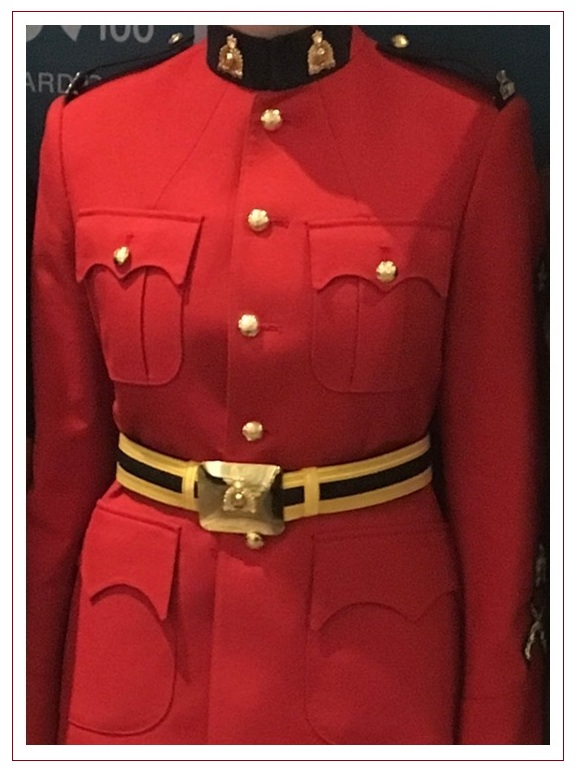
An Essay:
Who May Wear the Red Serge?
Authority, Law, and the Integrity of the Red Serge
Disclaimer: This essay is written in an exploratory, academic tone. It does not allege wrongdoing or assign blame to any individual, group, or organization. It seeks only to examine legal, symbolic, and institutional questions related to the RCMP scarlet tunic. The analysis presented here represents the author's interpretation of the relevant statutes and constitutional framework. It does not constitute legal advice. The author is not a lawyer.
The critical question, for instance, of whether the Governor General of Canada may wear the uniform of the Royal Canadian Mounted Police is not primarily a matter of protocol, tradition, or ceremonial courtesy. It is, on the analysis presented here, a question of law. A review of the relevant statutes and regulations — the RCMP Act, the Royal Canadian Mounted Police Regulations, 2014, and the constitutional framework governing both the Office of the Governor General and the RCMP — does not identify any provision that would appear to create an entitlement for the Governor General, or VIP, or any other civilian, to wear the Red Serge. That conclusion is the author's own interpretation and does not constitute legal advice.
The same legal principles that appear to bar the Governor General from wearing the Red Serge apply with equal force, on this analysis, to civilian volunteers in pipes and drums bands. The uniform belongs to those who have earned it through oath, RCMP training, and sworn service. No Governor General has ever worn the Red Serge. That unbroken restraint is not accidental — it reflects a principled legal and constitutional boundary that deserves explicit articulation.
I. Constitutional Authority and Its Limits
The Governor General occupies a position of extraordinary constitutional authority. As the representative of the Crown in Canada, the Governor General holds formal command authority over the Canadian Armed Forces under the Constitution Act, 1867. It is for this reason — and this reason alone — that a Governor General may wear a Canadian military uniform. That authority is constitutionally grounded, formally recognized, and expressly connected to the Office. On the analysis presented here, it does not extend, by analogy or implication, to the uniform of Canada's national police force. The RCMP and the Canadian Armed Forces are governed by entirely separate legal frameworks, serve entirely separate constitutional functions, and derive their authority from entirely separate sources. The fact that a Governor General may wear one uniform does not appear to create any entitlement, legal or otherwise, to wear the other.
II. The RCMP Is Not a Military Organization
The RCMP is not a military organization. As the Supreme Court of Canada confirmed in Mounted Police Association of Ontario v. Canada (Attorney General), 2015 SCC 1, RCMP members are independent civilian police — sworn peace officers whose authority derives from statute and whose accountability runs to the law itself. The Red Serge is the uniform of that sworn civilian police authority. Every person lawfully entitled to wear it has taken an oath of allegiance, completed training at 'Depot' Division in Regina, and accepted the full legal responsibilities of a peace officer under federal and provincial law. The uniform is, in the most precise sense, a public declaration of sworn identity. It communicates to the public that the person wearing it holds defined powers of arrest, detention, and compulsion — powers that no civilian, regardless of rank, title, or constitutional office, possesses.
III. The Statutory Framework and What It Does Not Provide
The Governor General holds no sworn police authority. A review of the RCMP Act, the Royal Canadian Mounted Police Regulations, 2014, and associated statutes does not identify any provision that confers upon the Governor General — or upon any other civilian — the right to wear the Red Serge. The same appears equally true of the Prime Minister of Canada and of any visiting head of state. No office, however powerful or constitutionally significant, appears on this analysis to create an entitlement to wear the uniform of a sworn RCMP peace officer.
Section 27(1) of the Royal Canadian Mounted Police Regulations, 2014 places the design of the significant uniform under the approval authority of the Minister. The documentary record does not identify any provision within that framework creating a category of honorary or ceremonial entitlement, nor any exception based on constitutional office, political rank, diplomatic courtesy, or participation in a pipes and drums band. The documentary record released under the Access to Information and Privacy Act does not identify a document establishing any such entitlement.
IV. The Civilian Volunteer Parallel: When the Principle Is Not Applied
This analysis carries consequences that extend well beyond the question of the Governor General's wardrobe. The same statutory framework that appears to preclude the Governor General from wearing the Red Serge raises serious questions about the wearing of it by civilian volunteers in RCMP-affiliated pipes and drums bands, which has occurred since approximately 1998.
In February 2020, in the course of correspondence in which these legal questions were raised directly with a retired RCMP officer involved in establishing the civilian band program, the authority for that practice was described as resting not on any Ministerial approval, not on any provision of the RCMP Act, and not on any formal exercise of the statutory authority reserved under section 27(1) of the Royal Canadian Mounted Police Regulations — but solely on internal Senior Executive Committee (SEC) minutes from April 15, 1998. The following response was received:
"With respect to the uniform we wear, the authority lies with Commissioner Phil Murray — and the Sr Exec Committee minutes — that launched us in April 1998. It was his guidance and leadership that permitted the pipe bands to wear the red serge tunic with one modification to the bottom hem line of the tunic to accommodate the wearing of the kilt and sporran. He and his senior exec team were well aware of the fact that most of us would be citizen volunteers."
— Correspondence received by J.J. Healy, February 26, 2020. Reproduced with the knowledge of the author.
The civilian volunteers who relied on that decision acted in good faith. The question this research raises is not about their conduct — it is about whether the 1998 Senior Executive Committee decision itself constituted a lawful exercise of the authority required to permit civilian volunteers to wear the RCMP uniform, and whether the SEC had the statutory power to approve modifications to the significant uniform without Ministerial involvement.
That question turns on the RCMP Act and its Regulations. If the authority to approve modifications to the Red Serge is specifically vested by statute in a defined office or process, then it is not sufficient that a Commissioner and senior executives endorsed the practice administratively. The relevant question is whether the 1998 SEC decision was a procedurally valid exercise of the applicable statutory authority — or whether it was an administrative arrangement that was never formally grounded in the law that governs the significant uniform. The documentary record released under the Access to Information and Privacy Act does not answer that question. That is a finding of this research.
The civilian volunteers who participated deserved clear legal guidance at the time. Whether that guidance was ever properly established is precisely what this research seeks to determine.
When civilian volunteers wear the full RCMP Red Serge in pipes and drums bands, the appearance of official police authority may be created without the statutory foundation that such an appearance requires. Unlike sworn RCMP members, civilian volunteers hold no legal mandate, no police powers, and no sworn oath — yet in uniform they are visually indistinguishable from sworn RCMP members wearing the same pipes and drums dress. The public is entitled to assume that a person in the Red Serge is a sworn RCMP member. That assumption is the very message the uniform is designed to communicate. When that message does not reflect sworn status, the legal framework Parliament established to protect Canada's most significant national symbol warrants careful scrutiny.
V. Security Vetting: A Question the Documentary Record Does Not Answer
A further question warrants institutional attention. When RCMP-affiliated civilian volunteers in pipes and drums bands perform in the presence of the Governor General, members of the Royal Family, or other protected persons, a question arises that the documentary record available through the Access to Information and Privacy Act does not answer: whether those civilian volunteers have undergone security vetting comparable to that which sworn RCMP members performing ceremonial duties near protected persons are subject to.
This research was unable to determine from the documentary record whether civilian volunteers in RCMP-affiliated pipes and drums bands undergo security screening, and if so, what standard applies. According to documents released by the RCMP under the Access to Information and Privacy Act, a pipes and drums band appeared at a VIP visit in Fredericton, New Brunswick in June 1998 — within weeks of the Commissioner's formal approval of the civilian band program. The question of what vetting, if any, applied to civilian volunteers on that occasion is not answered by the documents released to date. It is a question the RCMP is best positioned to answer, and one that warrants institutional clarification.
VI. Authority Matters: The Supreme Court's Confirmation
As the Supreme Court of Canada confirmed in Mounted Police Association of Ontario v. Canada (Attorney General), 2015 SCC 1, RCMP members are independent civilian police, not agents of the government. That independence — and the sworn authority that defines it — is precisely what the Red Serge represents. The RCMP uniform is not a symbol of affiliation. It is a symbol of sworn legal identity. Sworn legal identity cannot, on the analysis presented here, be borrowed, assumed, conferred by administrative convenience, or extended by the goodwill of a Commissioner or any other officer acting outside the authority Parliament has prescribed. Whether the 1998 SEC decision met that standard is the central unanswered question this research identifies.
Conclusion
The integrity of the Red Serge rests on a single principle: it is worn by those who have earned it through oath, RCMP training, and sworn service. The Governor General of Canada, for all the constitutional dignity and authority that Office commands, has not taken that oath, has not completed that training, and does not hold the powers of a peace officer. No Governor General has ever worn the Red Serge. That unbroken restraint is not a matter of custom — it reflects, on the analysis presented here, a matter of law. The uniform of Canada's national police force is not a ceremonial garment to be conferred by rank, tradition, or historical tolerance. It is a legal identity. And in Canada, legal identity is earned — not assumed.
References
1 Royal Canadian Mounted Police Act, R.S.C. 1985, c. R-10. The foundational statute governing the Force, its members, and the Governor in Council's authority to make regulations concerning clothing and kit.
2 Royal Canadian Mounted Police Regulations, 2014 (SOR/2014-281), section 27(1). Governs the design and Ministerial approval of the significant uniform of the Force, including the scarlet tunic.
3 Constitution Act, 1867 (UK), 30 & 31 Vict, c. 3. The constitutional basis for the Governor General's command authority over the Canadian Armed Forces.
4 Mounted Police Association of Ontario v. Canada (Attorney General), 2015 SCC 1, [2015] 1 SCR 3. The Supreme Court of Canada's confirmation that RCMP members are independent civilian police officers, not agents of the government.
5 Correspondence received by J.J. Healy from a retired RCMP officer involved in establishing the RCMP pipes and drums program, February 26, 2020. Reproduced with the knowledge of the author.
6 Senior Executive Committee (SEC) minutes, April 15, 1998, Royal Canadian Mounted Police. The internal administrative decision cited as the authority for civilian volunteers wearing the Red Serge in pipes and drums bands.
7 Documents released to the author under the Access to Information and Privacy Act, R.S.C. 1985, c. A-1, obtained from the Royal Canadian Mounted Police. A review of all documents released to date contains no reference to Ministerial approval having been sought or granted for the wearing of the Red Serge by civilian volunteers in RCMP-affiliated pipes and drums bands.